
Legally, the right to claim a deceased person’s ashes belongs exclusively to the individual holding the formal "right of disposition." This is dictated by strict state-level kinship hierarchies—typically starting with a designated agent, followed by the surviving spouse, and then a majority vote of all surviving adult children. Contrary to widespread assumptions, the executor named in a last will and testament does not automatically possess the legal authority to claim ashes, nor are cremated remains treated as standard inheritable property that can be casually split among heirs.
Because cremation permanently transforms a human body into movable, transportable matter, it has inadvertently birthed a chaotic new frontier in family law. When families fracture over funeral plans, ashes become the ultimate hostage. Siblings who have not spoken in decades suddenly find themselves locked in bitter legal standoffs, paralyzing funeral homes and forcing local courts into the uncomfortable position of deciding who gets custody of a parent.
Understanding exactly how disposition laws function, why funeral directors immediately halt services at the first sign of conflict, and how to bulletproof your own final arrangements is essential to sparing your surviving family from toxic, emotionally devastating property disputes.

The Legal Reality of "Quasi-Property"
Most families assume that human remains are treated just like the deceased’s bank accounts or real estate. This is technically false. In the legal system, a human body, and subsequently its ashes, possesses a unique status known as "quasi-property." This doctrine exists specifically to outline rights for the purpose of burial or disposition, rather than financial inheritance.
Because a person cannot legally be "owned," courts treat the right to control the remains as a sacred duty rather than an asset allocation. However, because cremation results in physical ashes that can be kept in a living room, scattered across an ocean, or divided into jewelry, the line between sacred duty and literal ownership rapidly vanishes in the eyes of grieving relatives.
This legal ambiguity is exactly what creates room for lawsuits regarding the wrongful infliction of emotional distress during a funeral. If one sibling legally claims the ashes and maliciously hides them from the others, the excluded family members must file civil injunctions—often demanding the return of the ashes under a legal action known as "replevin," a mechanism normally used to recover stolen cars or disputed artwork.
Scene Moment: The Standoff at the Mortuary
Michael sat rigidly in the funeral home’s arrangement room, exhaustion radiating through his shoulders. Across the table, his estranged sister, Elena, had her arms crossed defensively. Their mother had died suddenly 72 hours prior, leaving no written directive. Michael wanted to inter the ashes in the family plot beside their father. Elena demanded the urn be handed directly to her so she could scatter the ashes in the Mediterranean, a trip she allegedly promised their mother privately.
The mortuary manager slowly withdrew his hands from the authorization paperwork resting on the table. "I’m sorry," he said, citing strict corporate legal policy, "but until the two of you reach a signed consensus, or until I receive a court order, these ashes cannot be released. They will remain in our secure holding facility indefinitely." In an instant, the grief process paused, replaced by an impending legal battlefield.
The Hierarchy of Disposition Rights: Who Has Custody?
When someone dies without explicitly naming an authorized agent for disposition, authority falls strictly to a state-mandated chain of command. If you wish to protect your final arrangements, you must understand who the law puts in charge by default. Next of kin laws follow a rigid, cascading order of authority.
- The Legally Appointed Agent: Someone named explicitly in a state-approved Appointment of Agent for Disposition of Remains form. This supersedes all family members.
- The Surviving Spouse: If legally married (and in some states, not actively undergoing divorce or legal separation), the spouse holds unilateral control.
- The Majority of Adult Children: This is where the highest volume of legal disputes occurs. The law usually requires agreement among the majority of competent adult children. In a family of three siblings, two must formally agree.
- The Surviving Parents: If no spouse or children exist, authority falls to the parents of the deceased.
- The Majority of Adult Siblings: A secondary tier of severe conflict, common when unmarried individuals with no children pass away.
For example, California Health and Safety Code Section 7100 clearly outlines this exact hierarchy, creating an enforceable blueprint that courts and mortuaries must follow to the letter. If you are estranged from your spouse, but not legally divorced, they still possess absolute, unchallengeable control over your ashes under this code unless you have intervened with legal documentation.
Common Mistakes That Spark Custody Wars Over Remains
The machinery of estate dispute litigation thrives on ambiguity. The vast majority of family wars over ashes begin because the deceased made one of several fundamental, avoidable operational errors.
- Depending exclusively on verbal promises: "Mom told me she wanted to be scattered" means absolutely nothing to a probate judge or a funeral home without a signed affidavit.
- Appointing equal co-executors without a tie-breaker: Choosing a 50/50 split of authority between siblings is deeply perilous when emotional decisions concerning physical remains must be made.
- Assuming financial contribution guarantees rights: Paying the mortuary invoice does not grant you the right to walk out with the ashes. Funeral homes will eagerly accept payment from a sibling, but only surrender the urn to the legally recognized next of kin.
- Ignoring blended family dynamics: Failing to formally sever rights from step-parents who have no biological tie, but carry full spousal disposition rights, frequently leaves biological children powerless over their parent's remains.
Why the Funeral Home Takes the "Safe Harbor" Route
To comprehend why an ashes dispute stalls seemingly overnight, you must understand the operational mechanics of the death care industry. Organizations like the National Funeral Directors Association (NFDA) heavily educate their members on liability management. Funeral homes are private businesses terrified of civil lawsuits.
When multiple relatives arrive at a mortuary demanding custody of an urn, the facility invokes what legal scholars call the "safe harbor" principle. By refusing to deliver the ashes to anyone, the funeral home essentially removes itself from the legal crossfire. They require the grieving family to either procure a mediated, signed settlement releasing the facility from liability, or a direct court decree specifying exactly to whom the cremated remains should be delivered.
During this delay—which can last months—the ashes sit in temporary plastic transport containers locked in the facility's storage room, racking up daily holding fees while the family hemorrhages cash on retainer fees for estate attorneys.
Meaningful Comparison: Standard Wills vs. Disposition Directives
It is a critical mistake to assume your Last Will and Testament is the correct vehicle for securing custody of your ashes. By the time a will is located, scheduled for probate, and officially read, you have likely already been cremated, and your ashes have likely been handed to the state-default next of kin. Estate disputes happen constantly despite valid wills.
| Feature | Last Will & Testament | Disposition Directive (Authorized Agent) |
|---|---|---|
| Timing of Execution | Usually accessed weeks after death, rendering funeral directives obsolete. | Effective immediately at the moment of death. Presented to funeral home prior to action. |
| Primary Purpose | Dictates financial asset distribution and guardian appointments. | Solely dictates who handles the physical remains and funeral execution. |
| Legal Binding Power | Subject to lengthy probate oversight and contestation windows. | Provides immediate statutory immunity to funeral directors who follow it. |
Scene Moment: The Splitting Dilemma
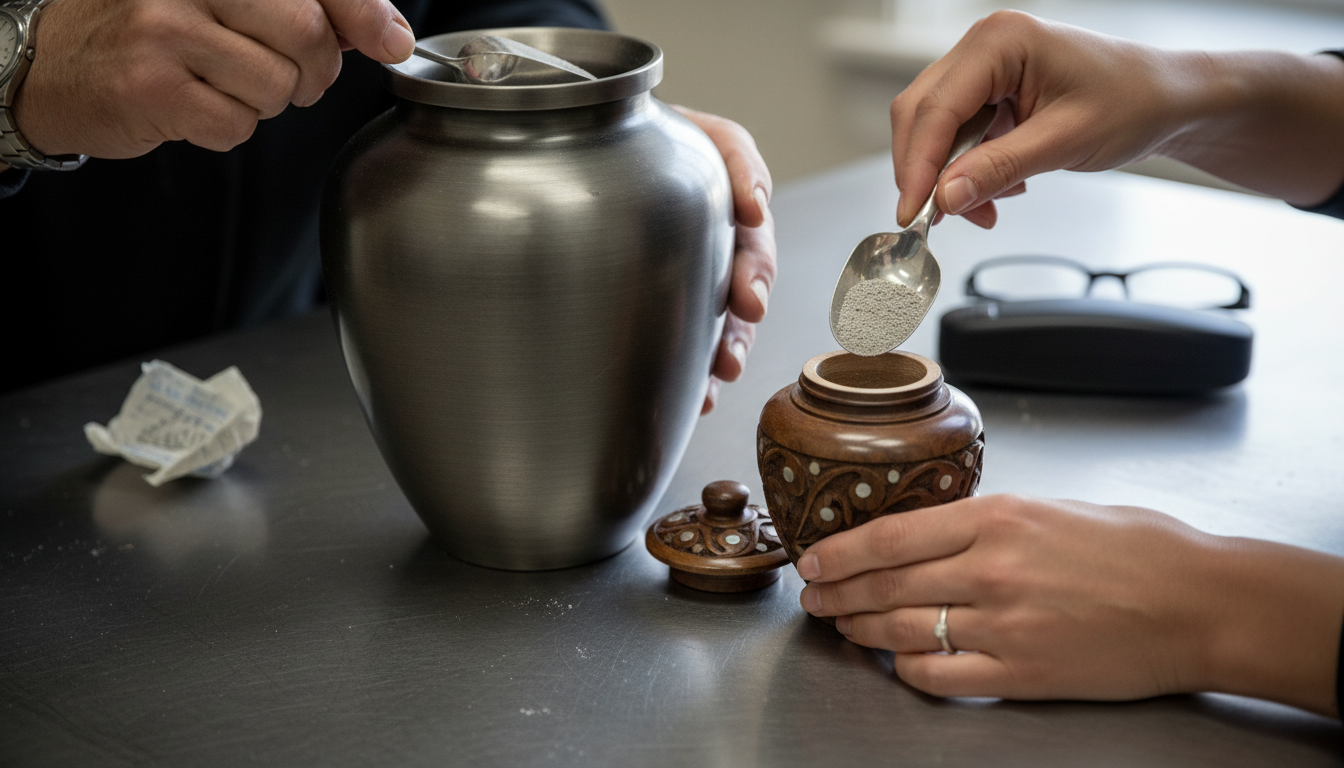
Weeks into their deadlock, Michael and Elena’s attorneys finally advised a practical mediation: splitting the ashes. The process, while legally sound, felt brutally clinical. They stood silently in the mortuary’s back preparation room as a technician, wearing sterile gloves, unsealed the thick plastic bag holding the five pounds of cremated remains. Using a specialized scoop, the technician systematically divided the dense ash between two smaller, ornate wooden urns.
Neither sibling looked at the other. While the physical separation ended the legal battle and satisfied the court's decree, the emotional fracture between the two surviving family members was permanently finalized across that stainless-steel table.
How to Bulletproof Your Final Arrangements
The only defense against a family custody war over your ashes is irrefutable, pre-planned intent. You must remove the ambiguity that fuels emotional distress lawsuits long before a crisis occurs.
- Designate a single agent: Use your state’s specific Appointment of Agent for Disposition form to name exactly one individual legally authorized to claim your ashes.
- Appoint a successor: Always name a backup agent in case your primary choice predeceases you or is unable to fulfill the duty.
- Draft clear geographical instructions: If you want your ashes scattered or placed in a columbarium, state the geographic location and facility explicitly in the directive.
- Centralize your documentation digitally: Paper documents locked in home safes are useless if your children cannot access them within 24 hours of your death.
This is where modern digital inheritance infrastructure fundamentally shifts the balance of power back to you. Cipherwill operates as a highly secured, zero-knowledge vault for detailed succession and executor guidance. Rather than hoping your family uncovers your state disposition forms in a filing cabinet amidst the chaos of bereavement, Cipherwill dynamically and securely transfers your critical documentation, final wishes, and asset access directly to your trusted beneficiaries exactly when they need it. It operationalizes your intent, stripping away the information vacuums that lead to bitter sibling rivalries, legal freeze-outs, and thousands of dollars in probate litigation.
Frequently Asked Questions
Question: Who legally gets the ashes if there is no will?
Answer: If no will or disposition directive exists, the ashes legally go to the first surviving profile in the state’s next-of-kin hierarchy. This is fundamentally the surviving spouse, followed by the majority of competent adult children, the parents, and then adult siblings.
Question: Can an executor take possession of the ashes?
Answer: Not automatically. Being named the executor of a financial estate does not legally grant the 'right of disposition' over physical remains unless that executor is also the next-of-kin or was explicitly named in a separate, valid disposition directive.
Question: Can multiple people keep the ashes?
Answer: Yes, cremated remains can be divided. Funeral homes routinely offer splitting services, distributing ashes into multiple keepsake urns or jewelry pieces to appease multiple family members and prevent prolonged legal battles regarding custody.
Question: What happens if siblings cannot agree on ashes?
Answer: If the legally required majority of siblings cannot reach an agreement, the funeral home will invoke a safe harbor policy and refuse to release the remains. The family must then seek mediation or file a petition in court for a judge to decide custody.
Question: Does paying for the cremation give me the right to the ashes?
Answer: No. Paying the funeral expenses is considered a financial contribution and does not legally transfer disposition authority. The highest-ranking next-of-kin retains full custody rights regardless of who actually paid the mortuary invoices.
Question: Can an estranged spouse still claim cremated remains?
Answer: In most states, yes. If the couple is legally married and a final divorce decree has not been ordered by a judge, the estranged spouse maintains absolute primary authority over the remains, bypassing biological adult children.
Question: How do I stop family members from fighting over my remains?
Answer: The strongest prevention is to complete a state-specific Appointment of Agent for Disposition form, distinctly naming one specific individual in charge. Vault this legally binding document in a platform like Cipherwill to secure immediate access upon death.
By Cipherwill Editorial Team, Reviewed by Cipherwill Review Board, Trust & Security Review Team
Editorial contributor: Myra Senapati
Review contributor: Ishani Debroy