The most secure digital location to store your will, estate plan, and sensitive family documents is a zero-knowledge encrypted digital vault equipped with a multi-factor dead-man’s switch. While digitizing your estate plan and abandoning an obsolete fireproof home safe is a strategic and necessary evolution, migrating those critical legal documents directly into Google Drive, iCloud, or Dropbox is an operational liability. Standard consumer cloud storage platforms fundamentally lack the specialized encryption protocols, automated beneficiary handoffs, and rigid legal compliance structures required for smooth inheritance distribution.
Treating a standard file-syncing service as an estate planning repository essentially guarantees friction. It exposes in-crisis families to irreversible technical lockouts, invasive probate delays, and complex compliance hurdles. When modern professionals move away from paper, they often confuse general cloud convenience with genuine vault security. This in-depth guide dismantles the technical failures of conventional cloud storage in emergency situations and outlines a comprehensive, compliant framework for deploying a resilient digital succession plan that actually functions when your family needs it most.

The Failure of Standard Cloud Storage: The Marcus Lockout Scenario
To comprehend the massive gap between cloud platforms and estate planning technology, consider the digital failure of Marcus, a 48-year-old architectural firm owner. Proactive about his business and personal finances, Marcus hired an attorney to finalize his living trust, drafted explicit distribution wishes for his assets, and rigorously consolidated his cryptocurrency seed phrases. Wanting his wife, Elena, to have immediate, barrier-free access if an emergency occurred, he scanned and placed all digitized documents into a dedicated Google Drive folder on his main personal account.
Assuming this digital preparation bypassed the complexities of physical probate, he voluntarily shared his master Google password with her. Four months later, Marcus passed away from sudden cardiac arrest during an out-of-state business trip. Amidst the immediate shock and the operational chaos of managing his architectural firm’s payroll, Elena opened a fresh laptop at her sister's house to retrieve the trust documents required by the estate attorney.
Google's sophisticated security algorithms instantly documented an anomaly: a new IP address, an unrecognized device, and a geographical location mismatch. The system flagged the login as a potential hostile intrusion and immediately triggered a two-factor authentication (2FA) verification block. The required SMS code was forcefully routed to Marcus's phone—a device that had been shattered during his medical emergency and was currently locked in a precinct evidence room.
Elena was instantaneously, and permanently, locked out of the estate paperwork. By relying on standard consumer cloud infrastructure without a dedicated legacy transfer protocol, Marcus had inadvertently built a digital vault so intensely secure that it successfully protected his life's assets from the exact person he intended to inherit them. Elena spent the next eight months paying premium legal fees to formally request access from the tech giant.
The Legal Reality: Custodian ToS Overrides Good Intentions
The severe disconnect between what users think they legally own and the bureaucratic hoops cloud providers force them through to execute a transfer is a primary friction point in modern digital estate planning. You do not truly "own" the folder in the cloud; you possess a revocable license to use it under strict behavioral rules.
Interpreting the RUFADAA Framework
In the United States, digital inheritance execution is heavily dictated by the Revised Uniform Fiduciary Access to Digital Assets Act (RUFADAA), a critical piece of legislation drafted by the Uniform Law Commission and adopted by the majority of states. RUFADAA specifically establishes that a platform's proprietary internal tool—such as a formal "legacy contact" or "inactive account manager" feature—takes absolute legal precedence over traditional physical documents like a Last Will and Testament or a Power of Attorney.
What does this legally mean in practical terms? It reveals a dangerous hierarchy. If you state in a legally-binding, notarized physical will that your executor has unmitigated rights to access your Google Drive documents, but you never formally configured Google's in-app digital legacy settings while you were alive, Google is completely within its legal right to ignore the paper will. The internal platform settings override your written executor designations.
Platform Terms of Service Prohibit Direct Password Sharing
Furthermore, according to the official Google Terms of Service, users are uniformly prohibited from sharing their login credentials. Even if a husband shares a password voluntarily and intentionally with his wife during life, a tech platform views any third-party login after death as an unauthorized, hostile breach of service. As explicitly outlined in Google's administrative policies for handling deceased users, their absolute primary responsibility as a custodian is to keep the original user's private data maximally secure—expressly prohibiting the direct transfer of passwords or login details to surviving family members.
This creates an exceptionally severe operational bottleneck for grieving families. A surviving spouse could logically possess a certified death certificate, an ironclad will, and court-issued letters testamentary, yet requesting data extraction directly from Big Tech custodians typically involves lengthy corporate legal reviews, soaring attorney fees, and the very plausible risk that the data will simply be permanently deleted to comply with overarching privacy regulations rather than securely transferred.
Comparing Standard Consumer Cloud Storage vs Heritage Digital Vaults
To truly comprehend why standard consumer drives catastrophically fail during succession transitions, one must look at their foundational programming architecture. Platforms like Microsoft OneDrive, Dropbox, and iCloud are masterfully built for active, living collaboration—daily file syncing, instant photo sharing, and rapid cross-device availability. They are fundamentally not engineered for posthumous data transfer. Specialized vaults designed specifically for inheritance operate on entirely different mechanical limits.
| Operational Feature | Standard Cloud (Drive / iCloud) | Specialized Inheritance Vault |
|---|---|---|
| Data Encryption Architecture | Server-side encryption (Platform holds the master keys and can legally scan files) | Zero-knowledge encryption (Only the creator and designated heirs hold keys) |
| Post-Life Access Trigger | Manual login strictly required (Requires ongoing 2FA approval from physical phone) | Automated Dead-Man's Switch (Monitors proof-of-life to intelligently release data) |
| Corporate Beneficiary Controls | Static shared folders (Easily revoked if original account is suspended for inactivity) | Time-released delivery protocols structurally isolated from general account suspensions |
| Legal Autonomy & Compliance | Governed heavily by corporate ToS focusing on shielding themselves from liability | Governed by specific fiduciary allocation rules set by the authentic asset owner |
The Encryption Gap: Why Zero-Knowledge Matters for Ultimate Privacy
When you drag a sensitive PDF outlining your last will, family trust, and medical directives into Dropbox or iCloud, the file is secured in transit and at rest using standard server-side encryption. The problem? The platform provider inherently holds the decryption keys. This means the host corporation, an ill-intentioned rogue employee, a highly sophisticated hacker who breaches the host server, or even a compelled governmental authority can theoretically access those files without your consent.
In the context of intensive estate planning, leaving intricate financial blueprints, minor children's social security numbers, crypto asset locations, and deeply private family declarations accessible to third-party server administrators is an unacceptable security flaw.
A proper, professional inheritance vault utilizes an infrastructure known as true zero-knowledge encryption. In this advanced cryptographic model, data is aggressively encrypted locally on your personal device before it ever begins transferring to the server. The platform storing the data is structurally blind; they only host indecipherable encrypted ciphertext. They physically cannot read your will, nor can they inadvertently hand it over in the disastrous event of a company-wide data breach. Only you, and the specific beneficiaries you mandate via unique cryptographic keys, maintain the mathematical ability to decrypt the final payload.
Uncommon Operational Risks: The Nightmare of Modern Lockouts
Standardizing around consumer cloud tools masks nuanced, severely stressful risks that families only uncover during the absolute peak of a crisis.
The Passive Inactivity Deletion Mandate
To minimize massive physical server costs, most modern cloud providers deploy aggressive inactivity sweeps. If you finalize and upload your meticulous estate plan to a cloud drive today, confident in your preparation, but then do not log into that specific account for two years, the system flags it as abandoned. The provider can and will permanently delete the entire account—taking the master primary copies of your trust directly into the digital abyss. Relying on an isolated archive you rarely interact with is a direct recipe for data evaporation. Beneficiaries frequently discover that by the time lengthy probate clearances happen, the shared cloud link they were relying on leads to an irreversibly purged account.
Scene Moment: The Emergency Room Paradox
Visualize a frantically stressed executor sitting in a brightly lit, chaotic hospital administrative office at midnight. An unconscious family member is in trauma surgery, and the critical medical staff urgently demands sight of a legally verified advance healthcare directive to proceed with a life-altering operation. The executor knows with 100% certainty it exists in a folder inside the patient’s iCloud storage. However, they lack the patient's FaceID marker. Because corporate giants do not accept physical Power of Attorney documents handed across the retail desk at a local Genius Bar, and navigating global corporate legal bureaucracies takes a minimum of three weeks, the critical medical document is functionally useless at the precise moment it dictates life or death. Operational speed dictates actual outcomes, and commercial platforms are profoundly unsuited for medical or financial emergencies.
Common Mistakes When Storing Sensitive Estate Documents Online
Protecting a generational digital legacy requires meticulous operational hygiene and consciously avoiding the systemic, intuitive errors that well-intentioned planners routinely make.
- Relying on Shared Master Password Managers: Providing an heir or attorney your singular master password to a digital vault circumvents necessary two-factor authentication barriers. If your localized authentication device (your primary phone) is medically unavailable, destroyed, or locked in a police impound, the heir is permanently blocked at the 2FA screen. The password alone is completely useless.
- Utilizing Regular Email as an Archive: Drafting and forwarding finalized will documents to an executor’s generic Gmail or Yahoo account leaves highly sensitive data sitting unencrypted in their inbox for years. This makes estate details incredibly susceptible to credential stuffing, routine phishing attacks, and malicious identity theft.
- Failing to Diversify Beyond Hardware: Hoarding critical files locally on a single, isolated encrypted external hard drive without a designated, cloud-fortified backup methodology guarantees that the estate dies if the physical hardware fails, is stolen during a break-in, is wiped by a power surge, or experiences long-term bit rot.
- Assuming Sweeping Spousal Exemptions: A dangerous assumption is believing a spouse automatically gains technical and legal access to a married partner’s solo cloud account after death. Tech platforms emphatically do not recognize marriage certificates as an authentication bypass protocol. You are a user ID to them, not a spouse.
Building a Resilient, Ironclad Digital Succession Framework
Transitioning your legacy out of vulnerable consumer-grade cloud services requires assembling a dedicated, intentionally designed pathway for document security and transfer. This process requires synchronizing legally valid preparation with highly specialized technological tooling.
Adopt the following comprehensive, four-step operational sequence to finalize your secure estate document framework:
- Execute and Notarize the Paper Fundamentals: Vigorously finalize your physical will, revocable trust, and advanced healthcare directives alongside a qualified estate attorney. Ensure all electronic scanned copies are properly indexed, thoroughly labeled without ambiguity, and updated synchronously with their physical, wet-ink counterparts.
- Deploy a Zero-Knowledge Inheritance Provider: Completely bypass traditional big tech ecosystems and enlist a platform structurally engineered exclusively for digital asset protection and posthumous transfer. Implement a technological infrastructure that respects privacy by design and holds zero capability of reading your documents.
- Configure an Automated Proof-of-Life Verification: Establish what is known as a continuous heartbeat protocol or proof-of-life ping (such as an encrypted app confirmation or periodic email). This mechanism acts as the central intelligence of your digital estate, quietly monitoring your well-being without invading your daily routine.
- Designate and Intentionally Educate Fiduciaries: Carefully pair specific trusted individuals to distinctly organized digital assets (e.g., your executor receives the trust, a business partner receives the LLC operational docs). Do not merely assign them in a vacuum; proactively sit down and educate them regarding the platform mechanics, precisely what a RUFADAA authorization means, and exactly what operational steps they must execute upon receiving notification.
The Ultimate Estate Document Security Constraint Checklist
Do not assume your family is secure until you can definitively affirm the following rigorous parameters:
- Are all deeply sensitive PDF trusts, medical directives, and cryptographic key spreadsheets fully shielded by verifiable zero-knowledge encryption protocols?
- Is a rigorously tested dead-man's switch actively enabled and calibrated to automate distribution and bypass 2FA if you unexpectedly become incapacitated?
- Have you logically mapped out an unassailable data recovery path that does not forcefully require physical access to your primary mobile phone or laptop?
- Does your traditional paper will explicitly mention the distinct digital vault holding the assets, granting sweeping fiduciary authorization directly compliant with the latest RUFADAA state regulations?
- Are all primary heirs highly aware of exactly where the master instructions reside, completely eliminating their need to blindly hunt through offline filing cabinets or guess online passwords during an emotionally devastating period?
Why Proactive Specialized Access Mechanisms Always Win
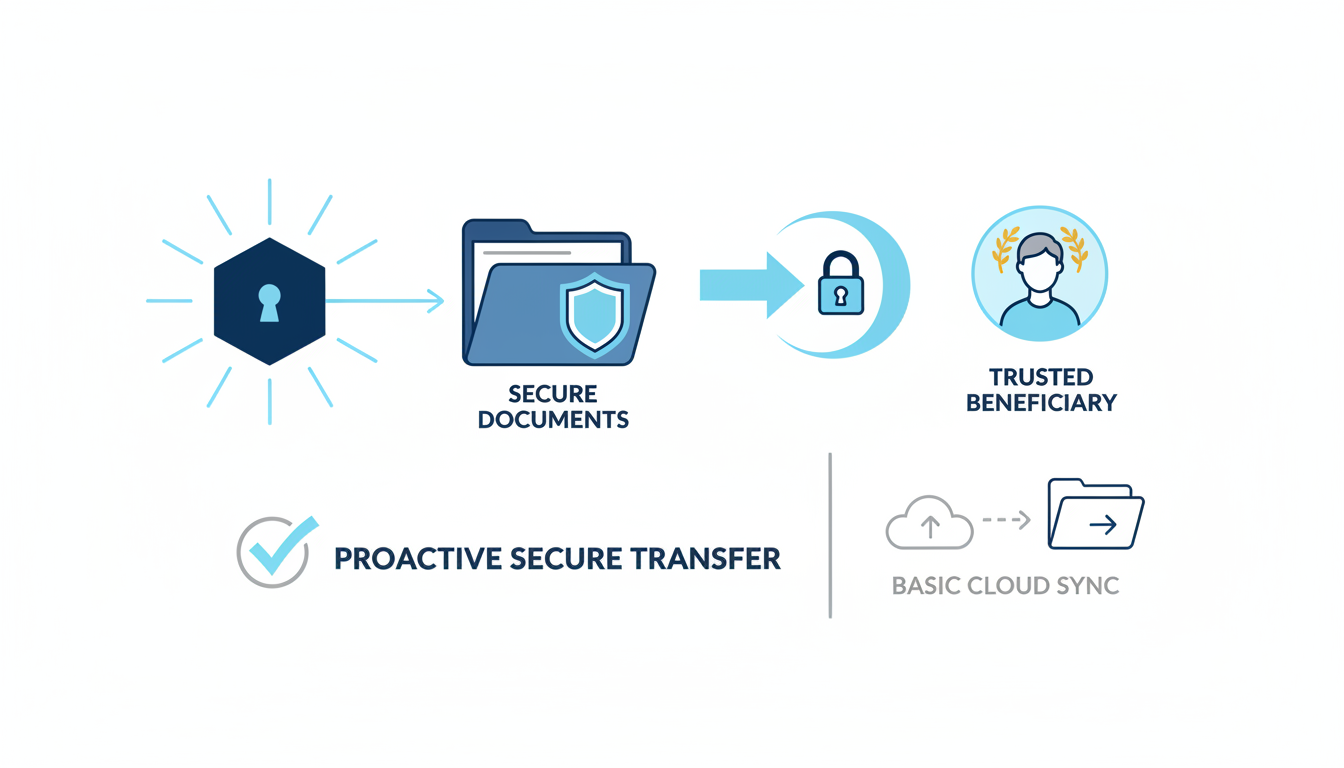
The most profound, defining architectural flaw of utilizing mainstream consumer cloud storage is its intrinsically reactive posture. Google Drive, Apple iCloud, and standard file hosts perpetually sit idle, patiently waiting for an authorized user to initiate a login. In a horrific tragedy or death scenario, the rightful user can simply never return. Because the platform remains passive, the entire burden to act aggressively shifts onto grieving, distracted families. They must somehow prove their detailed identity, painstakingly navigate endless corporate legal bureaucracy, hire specialized probate lawyers, and fight sophisticated authentication algorithms inherently designed to forcefully block them.
Specialized inheritance systems decisively reverse this exhausting dynamic through automation. They operate on a proactive architecture. By utilizing a continuous "check-in" system, the highly calibrated vault absorbs the responsibility of independently monitoring your active status. If you unfortunately fail to respond to the secure triggers over a timeline you meticulously pre-selected, the system independently deduces incapacitation. It immediately and autonomously initiates a rapid cascade of encrypted document handoffs directly to the inboxes and devices of your previously verified heirs.
"Most modern estate plans fail not because the underlying legal logic drafted by an attorney was flawed, but because the brutal operational mechanics required to actually access the digital documents in a crisis were entirely neglected. Your critical digital assets urgently require a proactive delivery agent, not just a passive storage unit."
A meticulously structured modern estate demands a technological infrastructure that seamlessly aligns impenetrable security with explicit legal intention. Regular cloud drives are an undeniably excellent societal tool for collaborating on project proposals and storing mundane tax receipts. However, they remain definitively, fundamentally unqualified to manage the transfer of generational wealth, secure final medical wishes, and guarantee absolute familial continuity.
Frequently Asked Questions
Question: Is it legally binding and valid to store my only will entirely online?
Answer: While maintaining encrypted digital copies is absolutely crucial for rapid medical and financial accessibility, the standalone legal validity of electronic wills (e-wills) remains wildly fragmented by state jurisdiction. In the vast majority of locales, tangible physical documents bearing notarized, wet-ink signatures remain strictly legally necessary to clear probate. Always securely retain the physical original in a secondary safe location while fiercely utilizing digital inheritance vaults to store high-fidelity master copies and immediate operational execution instructions for your executor.
Question: Why can’t my appointed executor simply log into my Google Drive if I deliberately give them the exact password beforehand?
Answer: Willfully logging in as a deceased or incapacitated individual constitutes a direct violation of virtually every major tech provider's strict Terms of Service regarding unauthorized access. Furthermore, from an operational perspective, if you correctly enable multi-factor authentication for basic security, your executor will invariably hit an impenetrable roadblock requiring a live SMS code or an authenticator app approval from your physical smartphone—rendering the shared password entirely useless.
Question: What formally happens to my massive Google Drive archive if I pass away without configuring extensive digital inheritance protocols?
Answer: If an account remains largely inactive past predetermined thresholds, Google’s automated compliance policies eventually schedule the entire dataset for permanent deletion to optimize server infrastructure. While surviving family members can rigorously attempt to submit court-ordered subpoenas and verified death certificates to formally request the data, the holding company heavily prioritizes blanket user privacy and routinely denies full total account access, decisively stranding critical legacy files.
Question: What exactly is a dead-man's switch in the context of high-level digital estate planning?
Answer: A dead-man's switch is a highly specialized, automated security framework that continuously monitors your life activity. By requiring you to periodically "check in" or interact via an email link or a secure app prompt, it cryptographically confirms you are alive and active. If you definitively miss a predetermined, successive number of check-ins, the autonomous system assumes sudden incapacitation or death and automatically, securely routes your encrypted documents to properly designated beneficiaries.
Question: How does zero-knowledge encryption functionally protect my private estate documents better than normal storage?
Answer: True zero-knowledge encryption guarantees that highly sensitive data is entirely scrambled and locked on your local device before structurally moving to the cloud server. The hosting company never possesses, nor can they magically generate, the required decryption keys. This mathematical certainty guarantees that your meticulous estate plans, expansive financial account numbers, and delicate private directives remain utterly unreadable to platform employees, malicious hackers, and unauthorized snooping third parties.
Question: Does a meticulously crafted physical will automatically override an internet platform’s designated legacy tool settings?
Answer: Under the robust mandates of the Revised Uniform Fiduciary Access to Digital Assets Act (RUFADAA), the definitive answer is generally no. A specific online legacy tool provided directly by a primary tech custodian (like a legacy contact setting in an app interface) explicitly and legally supersedes broader, generalized transfer provisions drafted in an older physical will or an overarching durable power of attorney.
Question: Are heavy fireproof home safes completely obsolete for modern family estate planning?
Answer: Physical foundational safes still hold distinct societal value for exclusively storing your solitary original wet-ink signature paperwork, physical gold, and tangible family heirlooms. However, they remain highly physically vulnerable to localized environmental disasters, careless misplacement, and targeted home burglary out during vacations. A genuinely secure modern estate universally pairs a heavily hidden, bolted physical safe with an advanced, robust digital inheritance vault, ensuring immediate, unblockable secure access for fiduciaries regardless of their catastrophic geographic location.
By Cipherwill Editorial Team, Reviewed by Cipherwill Review Board, Trust & Security Review Team
Editorial contributor: Iraan Qureshi
Review contributor: Tavish Bhonsle