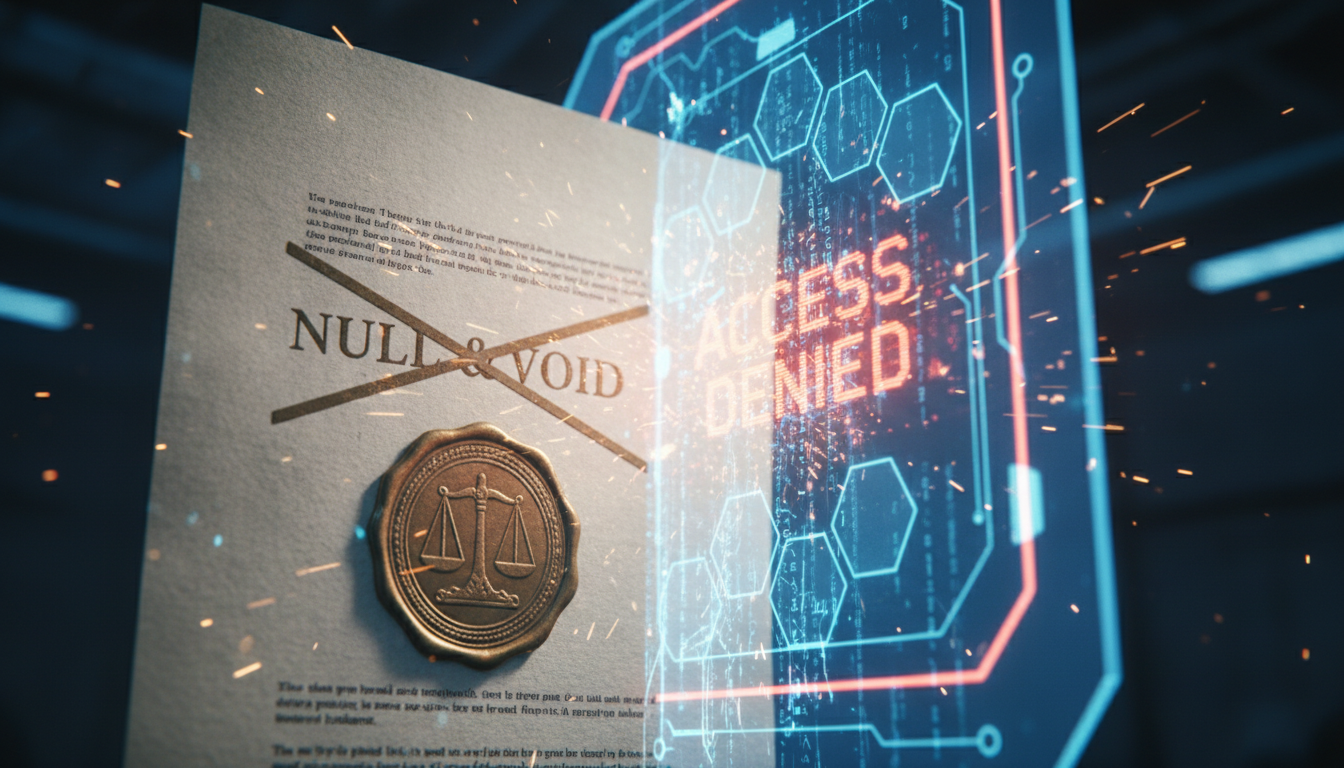
When sudden incapacity strikes, families quickly learn a harsh reality: a traditional, notarized power of attorney is often completely worthless to Big Tech. Companies like Apple, Google, and major cryptocurrency exchanges operate under strict federal privacy statutes and complex encryption architectures that do not easily yield to paper legal documents. A physical estate plan cannot override cryptographic keys, multi-factor authentication hardware, or strict corporate Terms of Service. If you are drafting a digital power of attorney for accessing accounts with POA, you must pair your legal authority with specialized incapacity planning tech. This guide explains the exact legal walls your agents will hit, why standardized estate planning for digital assets fails, and the technical frameworks required for building a secure encrypted inheritance that actually works.
The Bureaucratic Brick Wall: Sarah's Collision with Silicon Valley

To understand why standard legal frameworks fail, consider a highly realistic execution pathway. Sarah’s husband, David, suffered a severe stroke, leaving him medically incapacitated but alive. As the owner of a boutique design agency, David was the primary administrator for the company’s cloud infrastructure, banking applications, and client communication servers.
Sarah possessed a meticulously drafted Durable Power of Attorney, executed by a prominent law firm. She assumed she simply needed to present this document to Apple and Google to gain control of David’s accounts and run company payroll. Instead, her experience became a masterclass in bureaucratic rejection.
When Sarah submitted the notarized paperwork to Apple Support's legal portal, she was informed that a standard power of attorney does not automatically grant access to an iCloud account. Apple’s internal policies, designed to prevent unauthorized access and protect user privacy, required either a highly specific court order referencing digital assets or previous authorization through their internal "Legacy Contact" tool. Because David had not initialized the Legacy Contact feature, Apple’s support staff could not bypass the multi-factor authentication bound to David’s biometric hardware.
The legal authority Sarah held was irrefutable in a physical bank branch, but in the realm of encrypted data, legal authority means nothing without technical capability.
Why Big Tech Defies Traditional Estate Law
The friction between your family and Silicon Valley is not malice; it is statutory compliance. Tech platforms are bounded by federal legislation designed specifically to stop third parties from acquiring private communications.
The Shield of the Stored Communications Act
The primary legal wall defending corporate data silos is the federal Stored Communications Act (18 U.S.C. § 2701 et seq.). Enacted long before modern cloud computing, the SCA prohibits service providers from knowingly disclosing the contents of electronic communications without the explicit, lawful consent of the user. For a customer service representative at Google or Microsoft, handing over the contents of a Gmail or Outlook account on the strength of a generic paper power of attorney is considered a federal privacy violation. The financial penalties and reputational risk for tech giants drastically outweigh the inconvenience caused to an incapacitated user’s family.
"Technology providers do not look at a general power of attorney and see authority; they see a potential unauthorized disclosure lawsuit waiting to happen."
RUFADAA and the Hierarchy of Consent
To bridge this gap, the Uniform Law Commission developed the Revised Uniform Fiduciary Access to Digital Assets Act (RUFADAA). Adopted by the vast majority of U.S. states, RUFADAA creates a very specific hierarchy that dictates how a fiduciary can access data. Crucially, RUFADAA dictates that a user's instructions provided through an "Online Tool" (like Google's Inactive Account Manager) supersede contradictory instructions in a will or a power of attorney.
If a user does not utilize those proprietary online tools, the law looks next to the terms of the power of attorney. However, under RUFADAA, the document must contain explicit, highly specific language authorizing the fiduciary to access the content of electronic communications. A generic "authority over all financial matters and property" clause is legally insufficient to compel corporate tech compliance.
Legal Authority vs. Technical Reality: A Meaningful Comparison
Understanding estate planning for digital assets requires separating your legal right to an asset from your mechanical ability to retrieve it. Below is an operational breakdown of how traditional powers fail against modern security protocols.
| Security / Platform Mechanism | Traditional POA Capability | Actual Technical Requirement |
|---|---|---|
| End-to-End Encryption (E2EE) | Demand service provider decrypt data | Possession of the specific cryptographic decryption key. Provider has no backdoor. |
| Apple iCloud / Account Recovery | Request password reset or administrative takeover | Pre-setup 'Legacy Contact' or a specific court order detailing user consent. |
| Hardware Multi-Factor (YubiKey) | Demand bypass of hardware requirement | Physical possession of the hardware token and specific PIN. |
| DeFi Crypto Wallets (Self-Custody) | Prove legal ownership of the funds | Possession of the 12-24 word seed phrase. No corporate entity exists to sue. |
Common Mistakes When Accessing Accounts with POA
Families frequently make critical procedural errors when attempting to execute a digital power of attorney. Desperation combined with a lack of technical understanding leads to these common operational failures:
- Committing Computer Fraud: Attempting to simply log in using the incapacitated person’s saved passwords without explicit legal or systemic authorization technically violates the Computer Fraud and Abuse Act (CFAA) and platform Terms of Service, risking a permanent account ban.
- Emailing Unsecured Legal PDFs: Support desks are trained to reject emailed legal documents due to forgery risks. Documents often must be submitted through specialized legal intake portals built by the provider.
- Triggering Fraud Logic: Repeatedly failing FaceID prompts on a locked iPhone or iPad will eventually trigger the device's secure enclave to permanently wipe the encryption keys, destroying the data forever.
- Ignoring the Limits of SMS 2FA: Assuming you can receive a text code on the incapacitated person's phone fails when the cellular provider requires account verification (and an active PIN) to replace a lost SIM card or unlock a restricted account.

The Operations Framework: How to Build Conditional Tech Access
The only reliable way to guarantee that your agent or fiduciary can execute their duties is to remove Big Tech bureaucracy from the critical path entirely. This is achieved by shifting from a permission-based legal model to a possession-based technical model. You must proactively hand off operational capacity before the crisis occurs.
In practice, this means establishing a parallel access system that triggers conditionally. Instead of leaving your spouse or business partner to beg Google for access, you utilize incapacity planning tech that mathematically delivers credentials exactly when a specific condition is met.
Step-by-Step Implementation Framework
- Audit Your Multi-Factor Architecture: Map out exactly how you authenticate. Identify which platforms rely on authenticator apps, SMS text messages, hardware security keys, or biometric prompts. You cannot plan succession for assets if you don't know the mechanical barriers protecting them.
- Deploy Vendor-Specific Tools: Where available, immediately activate the proprietary tools demanded by RUFADAA. Set up Google’s Inactive Account Manager and Apple's Legacy Contact. Ensure the contacts designated in these platforms perfectly match the agents named in your legal power of attorney to avoid conflicting authority disputes.
- Draft RUFADAA-Compliant Clauses: Consult with an estate planning attorney to ensure your POA explicitly uses the phrase "authority to access the content of electronic communications" over all specific hardware, software, and cloud infrastructure you utilize.
- Establish a Conditional Discovery Vault: Use zero-knowledge architecture to store critical credentials, TOTP seeds, and hardware vault combinations. This vault must be engineered to release its payload only after a verified incubation period—this ensures your agent possesses the keys without requiring approval from a customer support representative.
Checklist: Operationalizing the Hand-off
Before considering your estate plan complete, verify that you have bypassed the most common technical fail points. Provide this checklist to your nominated executor or power of attorney.
- Verify that your main email account (the primary recovery point for all other services) has an emergency recovery mechanism distinct from your daily mobile device.
- Ensure backup physical access codes are generated for all authenticator applications (Authy, Google Authenticator) and stored in an encrypted inheritance platform.
- Confirm that your legal documents explicitly reference cryptocurrency, NFTs, or decentralized ledgers if applicable, as standard financial POAs rarely cover non-fiat asset classes.
- Provide clear operational directions (a Letter of Instruction) detailing which hardware keys open which laptops, and where those keys are physically stored.
How Cipherwill Automates the Digital Power of Attorney
The fundamental flaw in modern estate planning is the reliance on third-party corporations to interpret and honor your legal intents. Paper laws are inherently slow, demanding human review and judicial intervention. Cipherwill solves this by shifting the enforcement of your wishes from corporate legal departments to cryptographic mathematics.
Through our specialized architecture, we provide the technical infrastructure acting as the enforcement arm for your legal documents. We achieve this utilizing a dead man's switch—an automated protocol that actively monitors your live status. If sudden incapacitation occurs and you fail to interact with your designated check-ins, the system initiates an execution timeline.
Because we utilize time capsule encryption and zero-knowledge relationship keys, Cipherwill itself cannot read your data. The data remains heavily encrypted and fragmented until the specific conditional logic defined by you is met. When the medical or operational trigger fires, your designated beneficiary or power of attorney receives the direct localized ability to decrypt their designated payload. This mathematical process bypasses customer support desks, terms of service limitations, and bureaucratic delays, directly handing over the operational capability your family desperately needs.
Frequently Asked Questions
Question: Why won't Google accept a standard notarized power of attorney?
Answer: Google must comply with the federal Stored Communications Act, which heavily restricts handing over private communications without explicit user consent. Under RUFADAA laws, unless your power of attorney contains explicit language granting access to electronic communications, or you utilized Google's internal tools, their legal department will reject the document to avoid privacy lawsuits.
Question: What is a digital power of attorney?
Answer: A digital power of attorney bridges traditional legal authority with specific technical permissions. It includes RUFADAA-compliant legal clauses granting power over digital assets and is practically supported by systems that transfer decryption keys, emergency recovery codes, and operational credentials bypassing typical corporate support blockades.
Question: Can my agent just log into my accounts if they know my password?
Answer: Technically yes, but legally this is a precarious grey area. Logging in as another person often violates platform Terms of Service and could technically breach the Computer Fraud and Abuse Act. From a practical standpoint, multi-factor authentication usually blocks such attempts if the agent does not possess the physical hardware.
Question: Does a power of attorney work for cryptocurrency exchanges?
Answer: Centralized exchanges like Coinbase may process a highly specific POA coupled with an incapacity decree, though it takes weeks of compliance review. Decentralized wallets (self-custody) cannot be accessed via any legal document; your agent must physically possess the cryptographic seed phrase to access the funds.
Question: What is the difference between UFADAA and RUFADAA?
Answer: UFADAA was the original act that gave broadly sweeping access to fiduciaries, resulting in massive pushback from tech companies citing privacy violations. RUFADAA (Revised) created a privacy-first hierarchy, making it clear that platform-specific online tools and explicit user consent are required before a fiduciary can read digital communications.
Question: Fix my Apple ID access during incapacitation without a legacy contact, how?
Answer: If the Legacy Contact was not enabled prior to incapacitation, your appointed agent must obtain a highly customized court order that specifically mandates Apple to assist in the provision of access to the incapacitated person’s information. Standard powers of attorney will be uniformly rejected during this process.
Question: How does incapacity planning tech like a dead man's switch work?
Answer: A dead man’s switch continuously monitors a user's active presence via email, SMS integrations, or platform check-ins. If the user fails to respond for a predefined duration, the system assumes sudden incapacity or death and automatically decrypts and delivers secure credential payloads to designated trustees, bypassing corporate approvals entirely.
Question: Can an estate planner handle my digital assets entirely?
Answer: An estate planner can organize the legal framework and draft compliant legal documents, but they cannot grant operational access. True digital succession requires a partnership between rigorous legal drafting and robust technical architecture designed to securely deliver MFA codes, seed phrases, and encryption keys.
By Cipherwill Editorial Team, Reviewed by Cipherwill Review Board, Trust & Security Review Team
Editorial contributor: Samarjeet Vohra
Review contributor: Nivaan Khattar