Digital asset inheritance is the systematic legal and technical transfer of online wealth, cryptographic keys, and digital infrastructure to designated beneficiaries after an owner's passing. Modern digital wealth evaporates rapidly when reliant solely on traditional wills, because physical paper cannot bypass biometric locks, multi-factor authentication, or decentralized cryptography. If you hold decentralized assets or manage cloud-based businesses, preventing generational wealth loss requires a structural shift from passive documentation to automated inheritance platforms. By bridging the catastrophic gap between what you own and what your family can legally retrieve, automated systems guarantee an operational handoff of assets while maintaining zero-knowledge security during your living years.
When the owner of a complex digital footprint passes away, technology platforms and cryptocurrency exchanges default to one rigid, unforgiving protocol: total algorithmic lockdown. Algorithms do not understand grief; they understand unauthorized login attempts. Without automated distribution protocols, surviving family members frequently find themselves battling immovable corporate privacy policies and mathematical encryption that ultimately costs them their inheritance.
The Silent Threat of Algorithmic Lockdown
Marcus, a 42-year-old software agency founder, spent years quietly accumulating a highly decentralized estate. He held a mid-six-figure ledger of stablecoins spread across two offline hardware wallets, managed domain registrations for fourteen revenue-generating client applications, and maintained primary administrative control over his company's vast cloud infrastructure. He assumed his bases were fully covered because he had left a sealed envelope containing his master vault password locked safely inside a physical fireproof safe.
But when his business partner passed away unexpectedly, leaving behind an identical "paper fallback" strategy, Marcus witnessed the operational carnage firsthand. The deceased partner’s widow possessed the legally executed will and the master password. Yet, the exact moment the widow attempted a login from a new, unrecognizable device, the cloud platform's security algorithms triggered a Time-based One-Time Password (TOTP). That secondary authentication request pinged an encrypted smartphone completely bricked by iOS biometric protections. The password she held was technically accurate, but operationally useless. The assets remained indefinitely frozen behind an unbreakable security wall.
This scenario is not an anomaly; it is the mathematical default of modern cybersecurity. Hardware and software ecosystems are fundamentally designed to reject unauthorized access. Without an active distribution engine, you rely on heirs executing a perfect, uninterrupted chain of technological bypassing that usually ends in failure.

The Operational Failures of Passive Planning
For decades, estate planning relied on passive tracking. Families utilized static lists, safety deposit boxes, and unencrypted spreadsheets left in home offices. In the context of a digital footprint, these legacy methods become active liabilities. Relying on passive strategy ensures that key infrastructure decays before probate even legally opens.
Common Mistakes in Digital Wealth Transfer
- Ignoring the Auth Death Spiral: Assuming a written password solves the problem while forgetting that a new device IP address will immediately trigger text message verification to a locked phone.
- Falling Victim to the Expiration Cascade: Overlooking that when a deceased person's bank accounts are frozen, the associated credit cards are immediately declined. Auto-renewing SaaS businesses, hosting platforms, and domain names lapse and are deleted before families can intervene.
- Misunderstanding Decentralization: Treating decentralized tokens like institutional bank accounts. There is no customer support line to reset a forgotten wallet recovery seed phrase.
- Mistaking a Legal Right for Technical Capability: Believing a court order instantly compels technology platforms to grant total backend access to software architectures or encrypted servers.
Consider the sheer volume of missing assets resulting from these operational blind spots. According to blockchain forensic analyses, estimates suggest roughly 20% of all mined Bitcoin is already permanently locked away. That represents billions of dollars in irretrievable generational wealth, largely lost to sudden passings where private keys were never actively transitioned.
Legal Authority vs. Technical Viability
One of the most profound misunderstandings in modern estate planning is the gap between legal right and technical viability. Having legal authority over an estate does not obligate code, encryption, or corporate infrastructure to seamlessly bow to the executor's wishes.
To address this, legal bodies introduced the Revised Uniform Fiduciary Access to Digital Assets Act (RUFADAA). This legal framework, adopted by the majority of US states, attempts to harmonize probate law with modern digital reality. It allows fiduciaries the legal right to access and manage digital assets, but there is an enormous operational caveat.
"RUFADAA grants legal fiduciaries the right to request access from custodians, but it does not compel technology companies to violate their own encryption protocols or bypass multi-factor authentication chains."
Under RUFADAA, a tech giant might be legally obligated to provide a family with a "catalogue" of communication—a list indicating that an email was sent—but they are legally forbidden from disclosing the actual content of those messages without explicit, prior digital consent provided by the original user via the platform's native tools. If you have not utilized an active, dedicated system to declare beneficiary access, you are trapping your own heirs in a labyrinth of corporate legal appeals.
Comparing Traditional and Active Estate Methods
To comprehend why a paradigm shift is vital, families must critically evaluate the functional mechanics of how their current plans react to an unexpected trigger event.
| Recovery Metric | Passive Legacy Disclosures | Automated Transfer Platforms |
|---|---|---|
| Hardware Access | High failure rate due to biometrics and 2FA locks. | Circumvents need for hardware logs by routing credential packets safely. |
| Delivery Mechanism | Executor must locate manual physical documentation. | Triggered automatically by verified lack of life signals. |
| Cryptographic Security | Often compromised (photos of seeds, plaintext documents). | Maintains complete client-side encryption until execution. |
| Corporate Compliance | Requires multi-month legal reviews, subpoenas, or orders. | Pre-authenticates the transfer through native access design. |
The clear operational disparity proves that depending on a physical safe leaves technical recovery entirely to chance. An active environment removes chance from the engineering equation entirely.
The Implementation of Guaranteed Transfer Delivery
Following the alarming realizations about his own passive strategy, Marcus transitioned his digital footprint engineering. Specifically, he sought a method to mathematically guarantee that his wife could recover the decentralized assets, even if his mobile authenticator apps were destroyed in an accident.
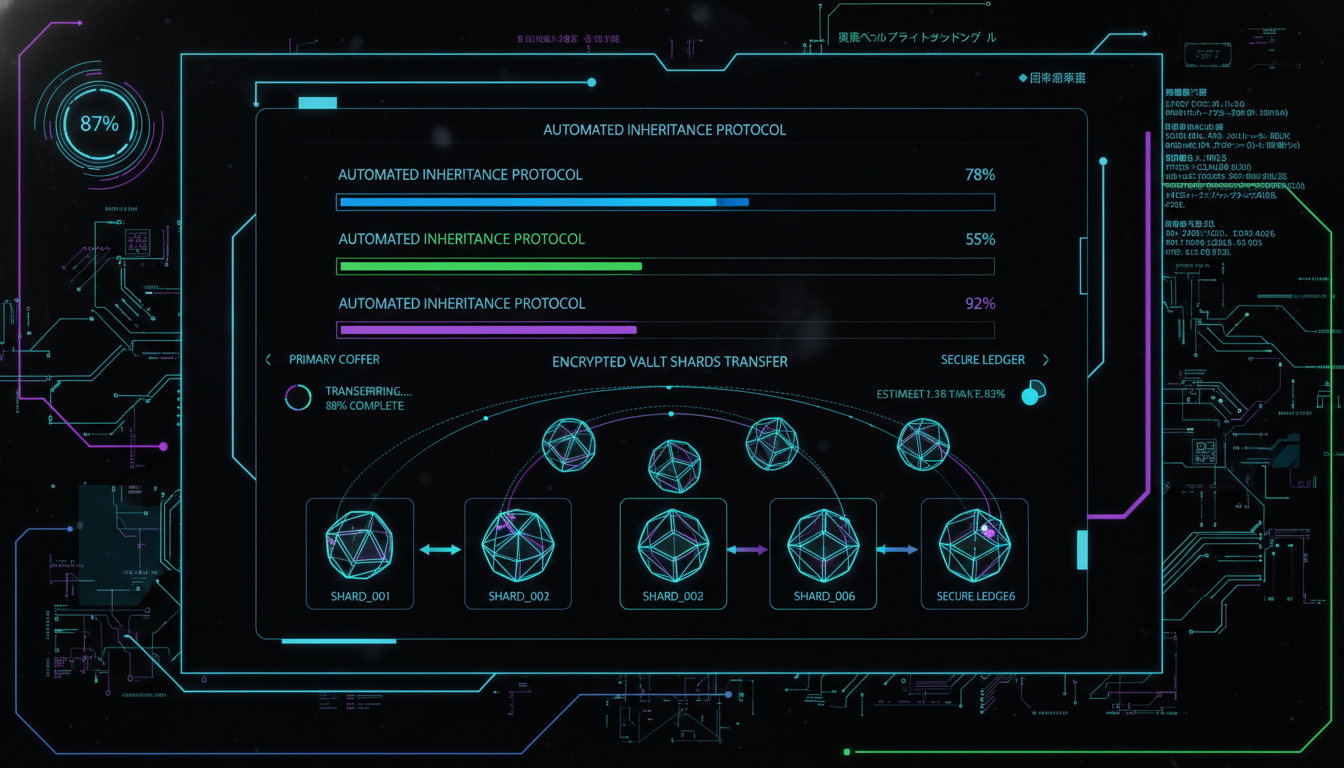
He achieved this by setting up a dead-man switch protocol through a dedicated digital inheritance vault. This architecture continuously pings the account owner with health checks—subtle periodic verifications requiring simple acknowledgment. If Marcus fails to respond across multiple layered communication channels within a predefined configuration period (and verified emergency contacts confirm the absence), the conditional switch trips.
Once triggered, the automated platform decrypts the localized vault shards exclusively for his designated beneficiaries. His wife no longer needs to break open the iPhone array or reverse-engineer his TOTP applications. The encrypted instructions, raw seed sentences, and administrative DNS routing codes are delivered natively to her verified environment. This effectively performs robust crypto estate planning without asking traditional probate attorneys to handle dangerous raw seed phrases.
The Operational Inheritance Execution Framework
Establishing an automated contingency plan requires meticulous mapping. You cannot securely transfer assets that you have not successfully identified. Follow this core execution checklist to fortify your structural handoffs.
- Audit the Authentication Chain Dependencies: Document exactly what multi-factor layers protect which assets. Note down when an account relies on an app, a physical security key, or an email domain you might lose control of.
- Separate Custodial from Non-Custodial Wealth: Treat brokerage accounts normally, as they integrate with standard RUFADAA probate processes. Isolate non-custodial decentralized wallets, as they exclusively require private key physical transfer.
- Select an Encrypted Execution Engine: Utilize a platform with zero-knowledge, fragment-based encryption. This allows you to construct emergency packets that even the platform’s engineers cannot decrypt.
- Define Escalating Trigger Mechanics: Calibrate the automation so that a missed notification doesn’t prematurely release your estate. Utilize tiered verification—where trusted family members act as secondary human confirmations.
- Provide Decoupled Operating Instructions: Include a plaintext letter walking beneficiaries precisely through what to do with the deciphered data. Getting a raw Ethereum vault seed is terrifying to an heir if they don't know the exact wallet interface to use.
By meticulously structuring these layers, you actively dismantle the silent deletion traps that ensnare modern wealth. The shift from a hopeful analog document to a decisive coded instruction is what separates a preserved estate from a multi-million-dollar lock-out.
Generational continuity in modern times is no longer a purely legal conversation; it is a cybersecurity imperative. When families choose active distribution environments like Cipherwill, they ensure their life's work easily survives the technology platforms originally designed to protect it.
Frequently Asked Questions
Question: What happens to my digital assets when I die without an automated system?
Answer: If you pass away without an automated transfer strategy, technology platforms will indefinitely freeze your accounts upon being notified of your death. Due to complex multi-factor authentication, non-custodial crypto assets will remain entirely unrecoverable on the blockchain, and web infrastructure connected to cancelled credit cards will quickly be deleted.
Question: Does a traditional paper will cover my cryptocurrency?
Answer: A traditional will can legally decree who is entitled to the financial value of the cryptocurrency, but it cannot override cryptographic mathematics. If the executor holding the will cannot locate or decipher your specific hardware ledger and precise recovery phrase, the legal entitlement becomes worthless.
Question: How does a digital dead-man switch actually work?
Answer: A dead-man switch is an automated security mechanism that performs scheduled life checks—like sending an email or push notification that requires a confirmation click. If you repeatedly fail to check in over an extended period, the system securely releases your encrypted private data directly to pre-designated family members.
Question: Can tech companies legally unlock my accounts for my family?
Answer: Under laws like the Revised Uniform Fiduciary Access to Digital Assets Act (RUFADAA), fiduciaries legally have the right to request access but tech companies are not forced to bypass their own encryption. Companies are generally prohibited from disclosing message contents to grieving families unless explicit prior consent was given.
Question: Are automated inheritance platforms secure against hackers?
Answer: Leading inheritance platforms employ strict zero-knowledge, end-to-end encryption frameworks. This means the service providers themselves do not hold the readable keys to your data; the information is completely siloed and mathematically fragmented until the precise conditional triggers securely assemble it for the beneficiary.
Question: What is the core difference between legal right and technical access?
Answer: A legal right is judicial permission to inherit property granted by a probate court judge. Technical access is the actual operational ability to log into a server, bypass authentication, and authorize a transaction. Without specialized technical access planning, your legal rights cannot bridge the firewall protecting the digital estate.
Question: Can I include administrative social media accounts in my digital inheritance plan?
Answer: Absolutely. Including login credentials, 2FA bypass codes, and instructions for major social media platforms is crucial—especially if those accounts govern business pages or generate ad revenue. Dedicated platforms allow you to route specific account credentials to the distinct beneficiaries managing those functions.
By Cipherwill Editorial Team, Reviewed by Cipherwill Review Board, Trust & Security Review Team
Editorial contributor: Samarjeet Vohra
Review contributor: Nivaan Khattar