
When you take a legal consultation with an attorney while a third party—like a parent, sibling, or friend—is present in the room or on the call, you are generally waiving attorney client privilege third party protections. This seemingly harmless act converts a legally protected, confidential conversation into discoverable evidence. The consequences of this operational oversight can be devastating during future litigation, as the bedrock of legal privacy is completely shattered by the presence of a non-client.
Consider the nightmare scenario of Julian, a young professional entering a high-net-worth marriage. Julian scheduled a crucial Zoom consultation with his probate and family lawyer to draft a rigid prenuptial agreement and structure a preliminary estate plan. Seeking comfort and quick financial context, Julian took the call from his childhood living room, with his mother sitting comfortably just out of frame on the sofa. Occasionally, she chimed in to clarify the deed structure of a shared family property. The attorney, eager to move the intake forward, failed to aggressively halt the meeting to verify who else was in the room.
Two years later, Julian’s marriage dissolved into a highly contentious, heavily litigated divorce. During the discovery phase, opposing counsel served an interrogatory explicitly asking if anyone else had been present during Julian's initial prenuptial consultations. Because lying under oath constitutes perjury, Julian was forced to admit his mother was in the room. In a devastating ruling, the judge determined that the inclusion of the mother stripped the entire conversation of its privilege. Julian's lawyer was subpoenaed and legally compelled to testify against him, forced to hand over their strategic notes and reveal Julian’s underlying financial anxieties and asset-shielding strategies. Julian lost millions, all because of an off-camera parent.
This catastrophe is becoming increasingly common. The convenience of remote legal communications has created unprecedented zoom privacy risks. Protecting your strategic intent and shielding your assets requires a modernized understanding of how the evidentiary rules actually work in an era where living rooms double as law offices.
The Evidentiary Mechanics of Privilege Loss
To comprehend the magnitude of this vulnerability, you must understand the rigid legal framework surrounding attorney communications. The primary directive governing legal privacy in the United States, as broadly standardized by the American Bar Association (ABA) Model Rule 1.6, requires an attorney to maintain the absolute confidentiality of information relating to the representation of a client. However, the evidentiary shielding of that information—which legally stops a judge from forcing the attorney to talk—only applies if the conversation happens in absolute confidence.
Legal statutes explicitly tie confidentiality to the intentional exclusion of outsiders. For instance, California Evidence Code Section 952 legally defines a confidential communication between client and lawyer as information transmitted in confidence by a means which, as far as the client is aware, discloses the information to no third persons other than those who are present to further the interest of the client in the consultation.

When you voluntarily bring a parent, a best friend, or a business partner into a consultation for "moral support," the law views this as an overt declaration that the conversation was never intended to be classified as a private secret. If you are comfortable sharing the sensitive details of your estate planning privacy alongside an external observer, the court assumes you have no reasonable expectation of total privacy. Consequently, the legal shield simply evaporates.
This technicality transforms virtual meeting spaces into dangerous environments. Ambient listening, where household members can casually overhear discussions involving asset transfers, living wills, and legacy preservation, fundamentally jeopardizes your structural legal defenses. Modern litigation discovery does not just rely on verbal admissions; opposing counsel routinely requests Zoom metadata, audio transcripts, participant logs, and AI-generated meeting summaries to identify rogue participants.
The Myth of the Parent-Child Legal Shield
A pervasive operational misconception is that family ties offer automatic legal protection. Because society is deeply familiar with the concept of "spousal privilege"—a distinct doctrine that generally protects communications between legally married individuals—many clients erroneously project this protection onto their parents or children. This assumption often results in individuals attempting to waive privilege by accident without realizing the magnitude of their procedural error.
In reality, there is strictly no blanket "parent-child privilege" recognized under general federal law, and the vast majority of state courts completely reject it. Unless your parent is explicitly retained as a co-client under a formalized joint representation agreement—a maneuver fraught with its own massive conflict-of-interest liabilities—their presence in the room makes them a civilian witness, highly vulnerable to depositions and subpoenas.
Consider a mini-scenario demonstrating this vulnerability: Sarah, a tech founder, brought her father to an initial estate planning meeting strictly to help her interpret complex tax jargon related to her equity options. Three years later, a major dispute erupted over the operational control of her company, ending in a civil lawsuit. The prosecuting attorneys quickly noted her father’s involvement in early legal correspondence. Because he was an unprotected third party, the opposition successfully deposed Sarah's father and aggressively interrogated him about every strategic weakness and proprietary fear Sarah had expressed to her lawyer during that initial meeting. Her father, under threat of perjury, had to betray his own daughter's strategic position.
This brutal legal reality underscores the primary axiom of modern wealth management: family legal meetings are a systemic liability unless explicitly orchestrated with rigorous legal foresight.
Common Mistakes: Unintentional Third-Party Waivers
Losing your legal armor rarely happens because of a dramatic courtroom outburst; it typically dies a quiet death through casual, daily digital habits. Understanding what specifically constitutes an unauthorized third-party disclosure can help you defensively structure your communications.
Here are the most severe, yet frequently committed, operational errors that destroy legal privilege:
- The "Background" Family Member: Attending remote legal consultations in high-traffic areas like dining rooms, open-plan offices, or shared vehicles where other adults can audibly process the conversation.
- The Collaborative CC: Forwarding an email thread containing your attorney's legal analysis to a trusted sibling, business partner, or un-retained financial advisor "just for a quick second opinion." The moment that email leaves the protected attorney-client silo, it becomes discoverable evidence.
- Unauthorized Virtual AI Note-Takers: Allowing third-party transcription bots (like Otter.ai, Fireflies, or Zoom’s native summary tool) into a secure legal meeting without ensuring the law firm explicitly controls the host environment and data retention policies.
- The "Joint" Parent-Child Consultation Trap: Scheduling a single session where an attorney advises both the parents and the adult child on overlapping generational wealth transfers without enforcing strict written waivers outlining conflicts of interest.
- Shared Digital Ecosystems: Conducting legal correspondence through a shared family email address (e.g., smithfamily@gmail.com) or a communal iPad that multiple individuals have unrestricted, unauthenticated access to.
"Legal protections evaporate the moment you treat privileged consulting as a collaborative family event. If an external party has visual, auditory, or digital access to your legal correspondence, you must assume opposing counsel will eventually read it."
The Exception That Proves the Rule: The Kovel Doctrine
It is a nuanced reality that attorneys frequently rely on external experts. If all third parties destroy privilege, how do lawyers work with forensic accountants or translators? The answer lies in the deeply specialized, legally restrictive agency exception, often referred to as a Kovel agreement, rooted in distinct federal case law principles outlined by institutions like the Legal Information Institute at Cornell Law School.
If a third party's presence is strictly necessary to absolute translation or interpretation of complex materials for the attorney to provide adequate legal advice, they may be shielded. A linguistic translator falls into this category. An incredibly complex niche corporate accountant explicitly hired horizontally by the attorney (not the client) may fall into this category. However, a parent attending a meeting to provide "emotional support," "guidance," or a "sounding board" definitively does not qualify under this strict legal exception.
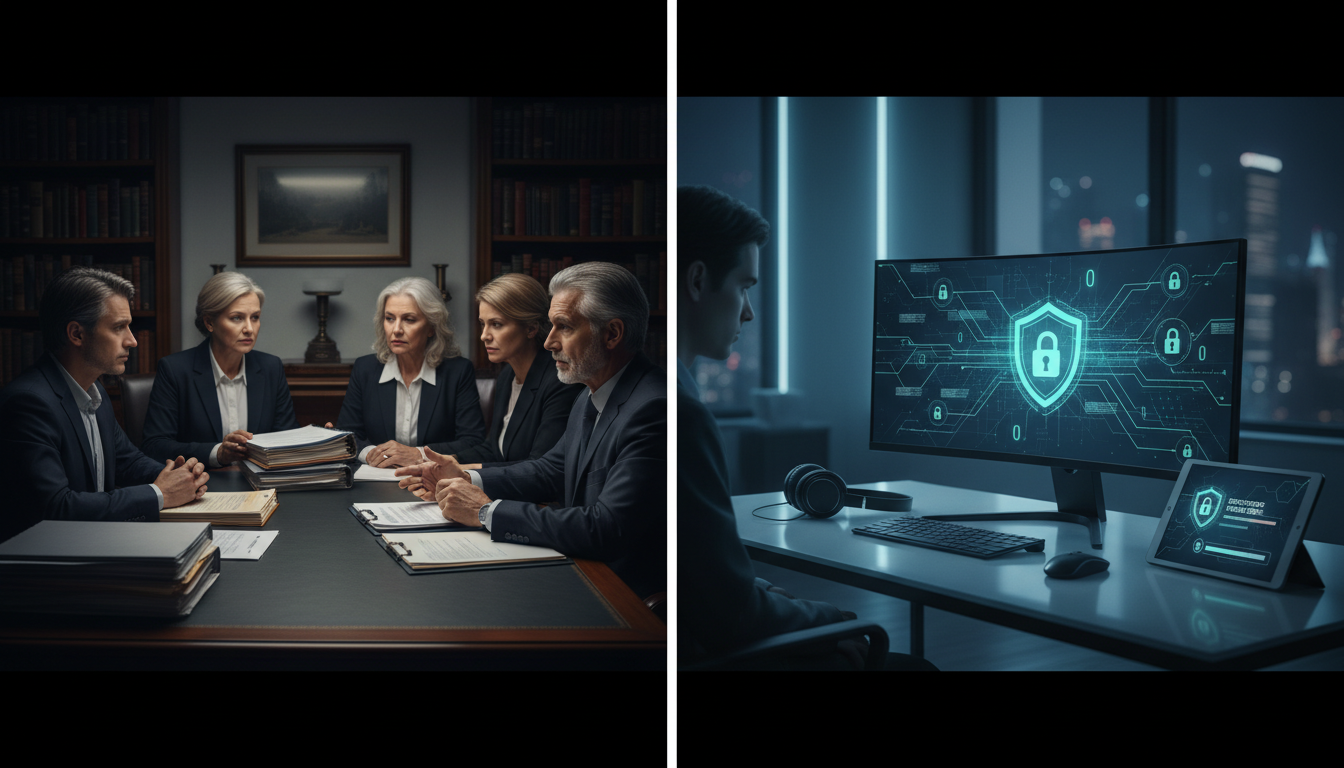
Comparing Traditional Disclosures vs. Zero-Knowledge Systems
As the inherent risks of having parents at lawyer meetings become increasingly catastrophic in modern litigation, independent wealth creators are migrating away from collective family legal discussions and moving toward highly compartmentalized, zero-knowledge digital environments.
Relying on physical proximity or shared digital platforms to organize your final wishes simply introduces too much operational friction. Analyzing the distinct contrasts between standard methods and advanced encrypted platforms highlights the critical need for isolated planning architectures.
| Operational Consideration | Traditional Family/Legal Workflow | Cipherwill (Zero-Knowledge Environment) |
|---|---|---|
| Third-Party Exposure | High risk. Relies on vulnerable Zoom calls, shared documents, and physical safe codes accessible by immediate family members. | Zero risk. End-to-end encryption ensures estate planning documents are formulated in absolute isolation. |
| Attorney-Client Privilege | Easily broken by forwarding emails, storing files on shared networks, or open-door remote meetings. | Preserved completely. Data is strictly cordoned off until the exact moment of a verified legal triggering event or demise. |
| Discovery Subpoenability | Shared family communications, raw emails, and unsecured drafting notes are prime targets for civil discovery. | Platform cannot surrender plaintext data due to cryptographic limitations, safeguarding initial drafts from hostile courts. |
Estate Planning Privacy: Implementation Action Framework
Safeguarding your strategic discussions requires aggressively controlling your operational environment. Before scheduling your next crucial meeting regarding asset protection, living wills, or trust formations, you must practically mandate the execution of the following defensive checklist.
- Enforce Hard Physical Isolation: Never take a legal consultation in a room where an unexpected guest could wander in. Close the door, utilize noise-canceling headphones, and explicitly inform your household that you cannot be disturbed under any circumstances.
- Verbally Confirm Environmental Sovereignty: At the outset of the Zoom call, explicitly state to your attorney on the record: "I am confirming I am entirely alone in this room, no one else is on the line, and I am intending for this meeting to remain fully privileged." This operational diligence establishes clear intent.
- Audit the Digital Lobby: Monitor the Zoom waiting room aggressively. Ensure your attorney has disabled automated transcription assistants unless deeply vetted, and cross-reference the participant list to guarantee no unknown internal firm staff or unauthorized family devices have joined passively.
- Compartmentalize Post-Meeting Directives: Do not immediately call your parents or partners to debrief the precise legal strategies discussed. If you must convey the outcome of an estate planning meeting, rely entirely on high-level operational summaries rather than explicitly detailing the lawyer's proprietary strategic warnings.
- Isolate Asset Checklists Using Independent Architecture: Avoid keeping raw asset inventories on communal cloud drives. Transition master passwords, account routing details, and explicit executor guidelines into a dedicated external inheritance platform that strictly manages access through cryptographic keys.
Organizing Sensitive Family Assets Without Exposing Intent
The underlying problem many clients face is the genuine, logistical requirement to pass wealth securely to their parents or beneficiaries without triggering premature liabilities. This paradox—how do I grant someone future access to my assets without legally involving them in the present-day legal structuring?—has traditionally been highly restrictive.
Rather than attempting to orchestrate complex family legal meetings where estate planning privacy is constantly at risk, secure digital platforms fundamentally shift the operational framework. Using Cipherwill, individuals independently compile, record, and execute their comprehensive estate decisions in a verifiable, zero-knowledge environment.
This architectural transition enables you to cleanly solve the core conflict. By utilizing an autonomous digital inheritance platform to silently log your cryptocurrency seed phrases, banking credentials, and private last wishes, you comprehensively insulate the drafting phase from parental oversight. You can seamlessly engage in building an independent estate plan securely masked from family assumptions, ensuring your core assets are safely locked behind a dead-man's switch protocol entirely beyond the immediate reach—and the legal risks—of your beneficiaries.
Consider another mini-scenario featuring Marcus, a real estate investor attempting to streamline a business succession plan while preparing for a major international surgery. Instead of holding a group consultation with his attorneys and aging parents, Marcus conducted all legal drafting completely alone, securing absolute privilege. He then utilized encrypted vaults to seamlessly structure your family emergency protocol, defining explicit rules about how and when his parents could eventually decrypt his localized financial ledgers if a catastrophic health trigger event occurred. Marcus protected his business from discovery subpoenas, preserved his privacy, and guaranteed his parents would securely inherit the required data at the appropriate time without ever stepping into a law office.
Frequently Asked Questions
Question: Does having my mom in the room waive attorney client privilege?
Answer: Yes, in the vast majority of cases, having any parent present during a legal consultation fundamentally destroys privilege. Because the parent is legally considered an un-retained third party, their presence signals to the court that the conversation was never intended to be maintained in absolute confidence, rendering the entire communication fully discoverable.
Question: Can a lawyer physically ask my parent to leave a consultation?
Answer: Absolutely, and highly competent lawyers routinely demand it. In order to protect you from future civil discovery risks and potential malpractice claims, an estate planning attorney should strictly require all non-clients, including parents and well-meaning spouses, to physically leave the room or disconnect from the Zoom call before substantive legal advice is deployed.
Question: Are Zoom auto-captions discoverable in court proceedings?
Answer: Yes, AI transcripts, participant logs, and embedded metadata generated by platforms like Zoom or Microsoft Teams are aggressively subpoenaed during modern litigation. If a bot transcribes a casual conversation with an unauthorized third party lingering in the background, opposing counsel can leverage that transcript to definitively prove you inadvertently waived your legal privilege.
Question: Does copying a friend on a legal email waive privacy limits?
Answer: Yes, forwarding or copying an unauthorized third party onto an email thread originally between you and your attorney immediately shatters the attorney-client privilege regarding everything written in that specific correspondence. You must rigorously compartmentalize legal communications and never casually share strategic advice via email threads with friends.
Question: Does attorney-client privilege apply to joint family meetings?
Answer: Joint family meetings are only protected if every individual in the room has explicitly signed a joint representation agreement with the singular law firm. This framework creates immense conflicts of interest. Without these executed waivers, the collective group interaction acts as a mass waiver, legally stripping privacy from the individual conversations held therein.
Question: How can I share estate plans without ruining operational privilege?
Answer: The safest operational method is completely isolating your legal drafting phase from your beneficiaries. You should utilize secure, zero-knowledge platforms like Cipherwill to independently stockpile encrypted instructions, asset locations, and legacy directives, ensuring beneficiaries strictly receive access only after death, rather than prematurely involving them in the protected legal review procedures.
Question: What is the agent exception to third-party privilege rules?
Answer: The core agent exception, often linked to the Kovel doctrine, allows specific specialized third parties—such as linguistic translators or specialized forensic accountants directly retained by the attorney—to attend meetings without destroying privilege because their professional presence is technically necessary to facilitate the effective legal representation of the primary client.
Question: Can I claim spousal privilege if my parent is on the Zoom call?
Answer: No. Spousal privilege relies entirely on legal marriage frameworks and completely evaporates in the presence of additional third parties. If you, your spouse, and your mother are collectively analyzing a legal problem on a video call, neither attorney-client privilege nor spousal privilege generally applies due to the presence of an unprotected observer.
By Cipherwill Editorial Team, Reviewed by Cipherwill Review Board, Trust & Security Review Team
Editorial contributor: Samarjeet Vohra
Review contributor: Tavish Bhonsle