
If you are acting as an executor trying to find deceased crypto assets belonging to a loved one, your search must immediately focus on four critical areas: scanning primary email accounts for exchange login receipts, inspecting unlocked smartphones for two-factor authentication (2FA) apps, searching bank statements for fiat-to-crypto wire transfers, and manually tearing through home offices for 12-to-24-word seed phrases. Grieving is an exhausting, visceral process; forcing families to play digital detective is inherently cruel. Recovering a digital inheritance is essentially a high-stakes scavenger hunt that requires methodically connecting fragmented digital footprints across disconnected devices before operating systems update, hardware batteries fail, or platforms permanently lock families out.
The Anatomy of a Digital Lockout
When David died suddenly at forty-two, his younger brother Marcus was handed the keys to his apartment and a paralyzing realization: David's life savings were almost entirely stored in cryptocurrency. There was no estate map, no updated legal will explicitly mentioning digital assets, and no documented instructions left behind for his surviving family.
Marcus spent his first three weeks of profound grief emptying file cabinets, staring blankly at David's locked smartphone, and frantically trying to bypass passwords on old laptops. He wasn't just trying to close accounts; he was desperately trying to recover dad's crypto on behalf of David's young children. The scent of stale coffee and dusty paper filled the room as Marcus sat on the floor, surrounded by disconnected hard drives, utterly terrified that a single wrong computer keystroke or an incorrect password assumption could irreversibly erase his brother's entire financial legacy.
This is the silent crisis of intestate descent in the modern era. When a loved one passes away without establishing a clear digital pathway, families are thrust into an agonizing labyrinth where traditional legal authority holds surprisingly little power over decentralized cryptography.
Phase 1: Digital Forensics and Evidence Gathering
To successfully execute a digital inheritance scavenger hunt, families must begin by charting the deceased's digital footprint. Digital asset platforms leave distinct administrative trails that executors can analyze even before attempting to log in.
- Audit Primary Email Archives: Search inbox histories for terms like "Coinbase," "Kraken," "Binance," "withdrawal successful," or "KYC approved." Centralized platforms frequently email users regarding compliance updates or transaction receipts.
- Trace Bank Statement Emigrations: Review the deceased's checking accounts from the past five years. Look for ACH transfers pushed to known crypto exchanges or Plaid API connections linking the bank to a trading account.
- Analyze Tax Returns for IRS Checkboxes: Review the decedent's most recent tax filings. The Internal Revenue Service (IRS) explicitly requires taxpayers to answer whether they have received, sold, or disposed of digital assets on Form 1040. A checked "Yes" box confirms the existence of crypto during that fiscal year.
- Inspect Web Browsers for Cryptographic Extensions: If you have legitimate access to the deceased's personal computer, carefully check the browser taskbar for installed Web3 extensions like MetaMask, Phantom, or Keplr, which indicate self-custody wallet activity.
Phase 2: The Crypto Estate Checklist for Physical Hiding Spots
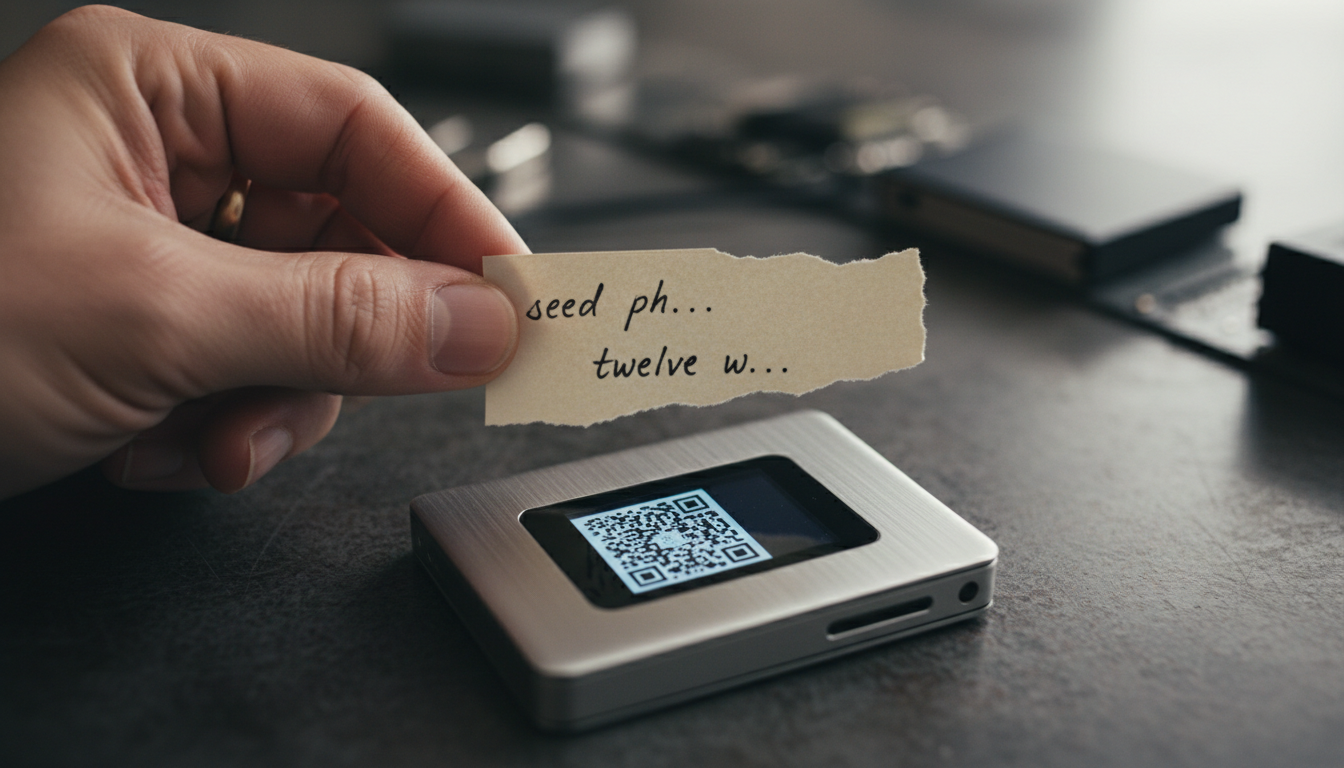
Self-custody cryptocurrency is governed by private root keys usually represented as a 12 to 24-word phrase. Understanding how to find secure passphrases requires assuming the mindset of someone trying to protect their wealth from both physical theft and digital hacking. People rarely save these master passwords in easily searchable text files.
When initiating a physical property sweep, utilize this actionable checklist to search highly probable offline hiding locations:
- Personal Libraries and Books: Check inside the jackets of favorite hardcover books or Bibles for index cards containing random sequences of English words.
- Fireproof Document Safes: Look for heavy, credit-card-sized titanium plates. Many investors punch their seed phrases into metal to survive house fires or floods.
- Disguised USB Drives: Do not discard generic-looking thumb drives. Hardware wallets (like Ledger or Trezor devices) often resemble basic USB sticks but contain the encrypted keys to millions in digital liquidity.
- Safety Deposit Boxes: Check the decedent’s keychain for unlabeled brass keys, which often correspond to bank-issued safety deposit boxes where secondary backups are kept securely off-site.
- Desk Drawers and False Bottoms: Inspect the undersides of physical desk drawers, back panels of filing cabinets, or old smartphone cases for folded post-it notes.
The Legal Labyrinth: Overlooked Operational Realities
Executors often assume that possessing a death certificate and an administrative password grants them absolute authority to simply log into a deceased person’s computer and initiate fund transfers. Operationally and legally, this assumption is profoundly flawed.
According to the framework of the Revised Uniform Fiduciary Access to Digital Assets Act (RUFADAA)—which provides the legal standard adopted by the majority of United States jurisdictions—an executor's right to manage tangible real estate does not automatically grant them carte blanche access to digital account contents. Unless the deceased proactively provided explicit, legally sound consent in their estate documents specifically outlining the transfer of digital credentials, technology platforms are legally shielded, and often mandated, to restrict account access upon receiving an official death notification to protect user privacy.
Furthermore, families frequently trigger irreversible automated security lockouts due to telecom disconnections. It is highly recommended to keep the deceased’s mobile phone plan active and paid for at least one year. If a grieving family cancels the cell service to save monthly expenses, telecommunication companies will rapidly recycle the phone number. A stranger could subsequently inherit the number, inadvertently gaining the SMS authentication codes necessary to approve or deny centralized exchange access, permanently freezing the family out of platform recovery flows.
Custodial vs. Non-Custodial Wealth Recovery
The method of recovering digital wealth changes entirely based on how the deceased interacted with the blockchain. Centralized exchanges act like modern banks, while decentralized hardware wallets act like impenetrable digital bears traps.
| Recovery Variable | Centralized Exchanges (e.g., Coinbase, Kraken) | Decentralized Wallets (e.g., Ledger, MetaMask) |
|---|---|---|
| Access Requirements | Certified death certificate, letters testamentary, court-ordered executor authorization, and specialized platform forms. | Requires physical possession of the correct 12-24 word seed phrase or the hardware device and its PIN. |
| Risk of Asset Loss | Funds remain intact but may be frozen in prolonged multi-year probate litigation. | High. The physical device can be permanently wiped after failed PIN attempts; complete loss if the seed phrase is missing. |
| Support System | Corporate customer support and legal compliance departments handle onboarding heirs. | None. Cryptography does not have a customer support hotline or a password reset link. |

The Discovery Moment: A Razor-Thin Margin of Error
Late on a Tuesday evening, after weeks of pursuing digital dead ends, Marcus accidentally knocked a heavy copy of Frank Herbert's Dune off David's highest bookshelf. As the book hit the hardwood floor, a folded index card slipped from the binding. On it were handwritten words: apple, orbit, jump, river, abstract...
It wasn’t a bizarre poem or a shopping list; it was a BIP39 mnemonic seed phrase. While finding it brought an overwhelming wave of relief, holding that flimsy piece of paper made Marcus viscerally furious. The financial security of his brother's surviving dependents had hinged entirely on a fictional sci-fi book falling open at the exact right angle. This operational fragility is unacceptable for modern wealth administration.
Fatal Errors: Common Mistakes Executors Make
The stress of probate often leads well-meaning families to make catastrophic technical errors. Attempting to force access without a holistic strategy regularly results in permanently destroyed funds.
- Bricking Devices via PIN Exhaustion: Hardware wallets like Ledger models have self-destruct mechanisms. If an executor guesses the device PIN incorrectly three times, the wallet securely wipes its own memory, permanently deleting the cryptographic keys.
- Formatting Electronics for Resale: In an attempt to clean up an estate, families often format "old" laptops or factory-reset smartphones to sell them or give them to grandchildren. This permanently wipes hidden software wallets and authenticator application tokens.
- Reporting Deaths Prematurely: Alerting a cryptocurrency exchange of a death before gathering relevant secondary inheritance documentation guarantees an immediate, strict account freeze. It is vital to consult with estate professionals before triggering platform lockouts.
- Ignoring IRS Valuation Requirements: Inherited cryptocurrency is subject to a step-up in tax basis, but executors must establish the exact fair market value of the volatile assets on the precise date of death. Failure to capture these historical snapshots accurately leads to severe tax auditing complications later.
"Assuming that traditional legal decrees will simply override the mathematical realities of cryptographic private keys is the most expensive mistake an executor can make during probate."
Breaking the Cycle: Preventing the Scavenger Hunt
The emotional trauma of hunting down digital assets should never be passed down as an inheritance. Proactive individuals who hold decentralized wealth refuse to leave their families in this terrifying position. Instead of hiding index cards in books or trusting generalized legal wills to manage specific cryptographic transfers, they build automated, failsafe pathways.
Using the Cipherwill platform, forward-thinking asset holders construct secure environments combining time capsule encryption with robust execution triggers. By setting up an intelligent dead-man's switch, holders ensure that their precise vault locations, seed phrase instructions, and operational contexts are automatically and securely delivered to trusted beneficiaries exactly when needed—and not a moment sooner.
Digital wealth demands digital architecture. Sparing your spouse, siblings, or children from the anxiety of a scavenger hunt is the ultimate act of modern estate planning.
Frequently Asked Questions
Question: How do you find a deceased person's crypto wallet?
Answer: Finding a deceased person's crypto wallet involves tracing their digital footprint by checking bank statements for fiat transfers and scanning emails for exchange receipts. Physically, families must search home offices for hardware USB devices, titanium backup plates, and 12-to-24-word seed phrases hidden in books or safes.
Question: Can a centralized exchange legally withhold funds from an executor?
Answer: Yes. Under strict privacy regulations and terms of service, exchanges are often required to freeze accounts upon learning of a user's death. They will withhold funds until the executor provides proper court-approved letters testamentary and identity verification aligned with local fiduciary frameworks.
Question: What happens if you cannot find the hardware wallet seed phrase?
Answer: If a family cannot locate the precise 12-to-24-word seed phrase and does not have the hardware device’s PIN, the decentralized cryptocurrency is effectively lost forever. There is no central authority, customer support hotline, or legal court that can forcibly reset cryptographic blockchain protocols.
Question: Does RUFADAA apply to decentralized crypto wallets?
Answer: While the Revised Uniform Fiduciary Access to Digital Assets Act (RUFADAA) gives executors legal standing to access digital property, it cannot bypass the mathematical reality of self-custody wallets. The law can compel corporate custodians like Coinbase to act, but it cannot unlock a decentralized hardware device without the key.
Question: Should executors try to guess the PIN on a locked hardware wallet?
Answer: No. Executors should never blindly guess PINs on hardware wallets. Devices like Ledger are intentionally programmed with a self-destruct security limit. Inputting an incorrect PIN three consecutive times will securely wipe the device's memory, rendering the stored digital assets permanently inaccessible.
Question: How does the IRS treat inherited cryptocurrency during probate?
Answer: The Internal Revenue Service generally treats inherited cryptocurrency similarly to traditional capital assets. Heirs typically receive a "step-up in basis," meaning the asset's taxable value is reset to its exact fair market value precisely on the date of the original owner's death, minimizing immediate capital gains tax.
Question: Why is it dangerous to cancel a deceased person's mobile phone plan?
Answer: Canceling the phone plan allows the telecom provider to recycle the number. If a stranger inherits that phone number, they could unknowingly receive two-factor authentication (SMS 2FA) codes intended for the estate, locking executors out of vital recovery channels for centralized financial exchanges.
Question: What is a digital inheritance scavenger hunt?
Answer: A digital inheritance scavenger hunt describes the exhausting process where grieving families must act as detectives. Lacking clear estate instructions, executors are forced to search for hidden passwords, encrypted devices, and misplaced seed phrases merely to identify and legally claim their deceased loved one's digital wealth.
By Cipherwill Editorial Team, Reviewed by Cipherwill Review Board, Trust & Security Review Team
Editorial contributor: Myra Senapati
Review contributor: Ishani Debroy