
Traditional estate planning fundamentally relies on legal authority—a judge signing a piece of paper compelling a bank to release a deceased person's funds. But in cryptocurrency estate planning, court orders are mathematically useless. Without a secure, operational mechanism to transfer private keys, your digital wealth is permanently lost, locked in a digital black hole regardless of what your last will and testament dictates. If you hold decentralized assets, you face an uncompromising operational reality: succession planning requires transferring cryptographic authority, not just legal possession.
For High-Net-Worth Individuals (HNWIs) and active DeFi participants, protecting a digital legacy requires a specialized, self-custodial inheritance framework. You must seamlessly transfer cryptographic access to beneficiaries in a trustless environment while preventing premature exposure to theft. This comprehensive guide dissects exactly why relying on legacy estate planning pathways destroys generational crypto fortunes, and outlines the precise technical frameworks necessary to secure your digital legacy.

The Illusion of Legal Compulsion in a Trustless Environment
The global banking system operates on an architecture of centralized trust and human overrides. When someone passes away, a court issues a letter of testamentary. The executor physically presents this document to a centralized authority—a bank or a brokerage—and the institution manually reassigns asset ownership. The legal decree functions as the master key.
Blockchain networks violently reject this model. The fundamental premise of decentralized ledgers is their trustless, permissionless nature. The blockchain only recognizes one master authority: the mathematical proof generated by a private key. Many individuals mistakenly believe that simply naming cryptocurrency holdings within a standard legal will somehow protects those assets. This is the single most catastrophic error in digital wealth transfer.
To illustrate the limits of the law, consider the Revised Uniform Fiduciary Access to Digital Assets Act (RUFADAA), which has been enacted across most of the United States. RUFADAA successfully grants authorized fiduciaries the legal right to access digital assets. If your assets are held on a centralized exchange like Coinbase or Kraken, RUFADAA provides a legal avenue to force the company to transfer the balance to your estate.
However, if you utilize self-custody—holding your Bitcoin, Ethereum, or DeFi tokens on a hardware wallet or decentralized protocol—the ruling is technically moot. RUFADAA grants the legal permission to access the assets, but it cannot grant the physical capability. A U.S. judge cannot issue a subpoena to the Bitcoin network. The protocol has no customer service desk, no compliance department, and no human oversight mechanism to override elliptic curve cryptography.
"Legal decrees grant permission. Cryptography demands execution. If an estate plan lacks the technical mechanism to execute a private key transfer, the legal permission is entirely worthless."
A Short Scene: The Probate Court Paradox
Imagine an executor standing in an attorney's office. In one hand, they hold a pristine, legally airtight Last Will and Testament, stamped and certified by the probate court, clearly bequeathing "all digital assets and cryptographic holdings" to the surviving spouse. In the other hand, they hold a physical Ledger Nano X hardware wallet, recovered from the deceased's home office.
The executor has absolute legal authority. Yet, when they plug in the device, a blinking screen demands an 8-digit PIN. Three incorrect guesses later, the device wipes itself. The legal authority remains pristine, but the asset value mathematically drops to zero in an instant. This is the paradox of applying 20th-century legal protocols to 21st-century cryptographic instruments.
The Anatomy of a Crypto Inheritance Failure: Marcus’s Analog Collapse
Understanding the specific operational failure points requires looking beyond theory. To analyze the systemic breakdown, we can trace the hypothetical, yet terrifyingly common, trajectory of a crypto investor named Marcus.
The Illusion of Preparation
Marcus, a seasoned Web3 investor, amassed a decentralized portfolio worth roughly $2.4 million, heavily staked in various DeFi protocols. Aware of the risks of losing his seed phrase, he took what he believed were responsible steps. He stamped his 24-word BIP39 mnemonic phrase onto a metal plate and placed it in a secure bank deposit box. He explicitly updated his traditional will to note the existence of this box, naming his sister as the executor.
The Analog Collapse
Following Marcus’s sudden passing, his sister begins the probate process. Traditional estate settlement takes time. For seven months, she is stuck navigating legal red tape just to obtain the necessary court documents to access his safe deposit box. During this period, the DeFi protocols where Marcus’s funds are staked experience severe volatility, but the family is powerless to intervene.
The Recovery Autopsy
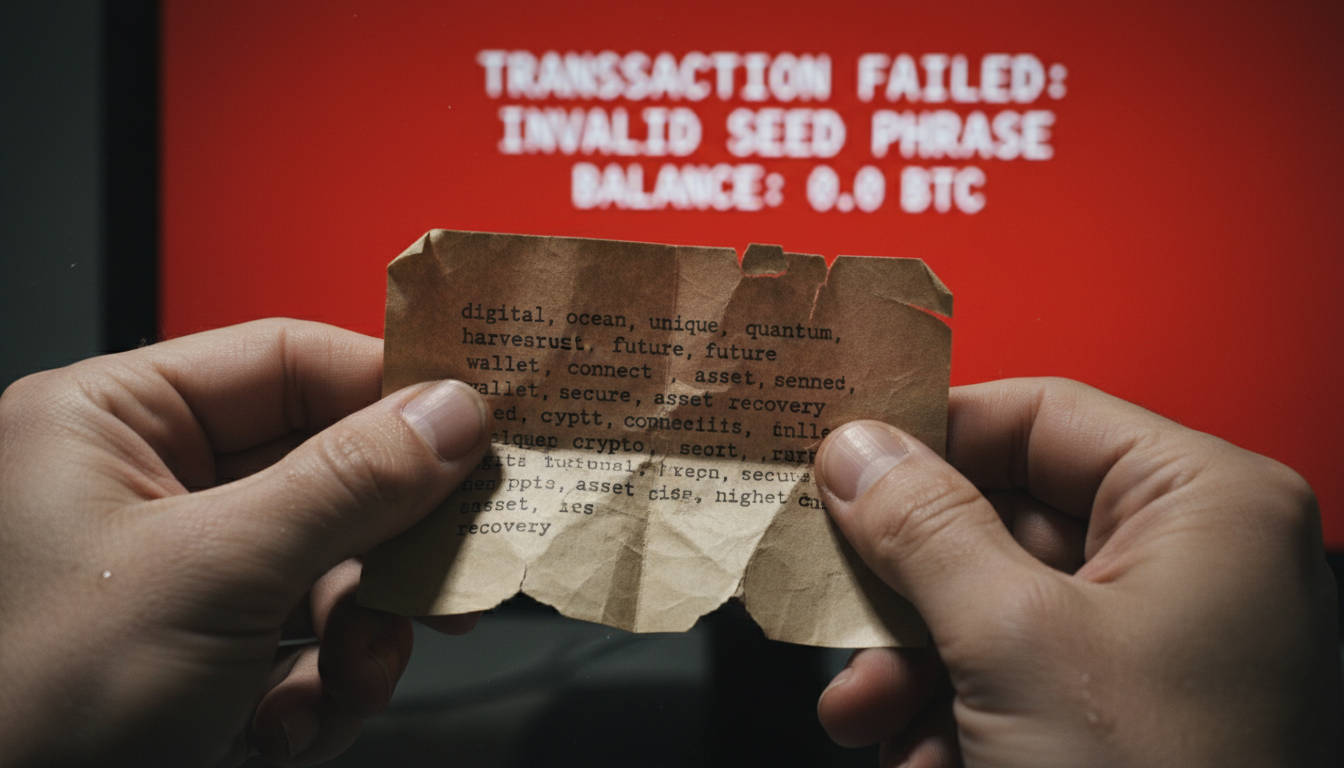
When she finally retrieves the metal plate, she expects asset recovery to be straightforward. She purchases a new hardware wallet and inputs the 24 words. The balance loads: $0.00. Marcus made a fatal, but common, technical oversight. He used a "25th word" passphrase, an advanced security feature, but failed to write it down with the base seed phrase, assuming he would always remember it. He also utilized custom derivation paths for specific secondary wallets. Because his inheritance plan relied on analog storage and human memory rather than a structured digital handoff, the majority of his decentralized wealth is permanently inaccessible.
Structural Comparison: Traditional Law vs. Cryptographic Reality
Understanding why these failures occur requires parsing the structural differences between how fiat capital and cryptographic capital move between generations.
| Operational Mechanism | Traditional Banking & Law | Decentralized Cryptography |
|---|---|---|
| Enforcement Authority | Court-appointed executor and financial institution compliance departments. | Mathematical consensus mechanisms requiring private key signatures. |
| Bypass Capabilities | High. Passwords, freezes, and locks can be administratively overridden. | Zero. A lost key mathematically implies permanently lost assets. |
| Asset Discovery | Bank statements, digital footprints, institutional subpoenas. | Invisible unless wallet addresses or seed phrases are explicitly provided. |
| Speed of Transfer | Subject to agonizing probate delays, often taking 6 to 18 months. | Instantaneous and programmatic if proper access is systematically transferred. |
Overlooked Operational Realities in Self-Custody
Estate planning documentation often overlooks the deeply technical and operational nuances of maintaining long-term digital asset custody. It is not enough to pass down a piece of hardware; the operational environment that the hardware requires must also be transferred.
Consider hardware firmware degradation. Hardware wallets from major providers frequently require firmware updates. If a device sits untouched in a safety deposit box for five to ten years while the owner is alive, the firmware may become entirely obsolete by the time the executor retrieves it. When plugged into a modern internet connected computer, the companion software may fail to recognize the legacy hardware, or the device may brick itself upon attempting an incompatible update. This means your beneficiaries need the raw cryptographic source material—the mnemonic phrases—not just the hardware.
Furthermore, relying on a beneficiary's technical competence introduces extreme execution risk. If a distressed spouse without technical context is handed 24 words, their first instinct is often to Google "how to recover crypto wallet." They are immediately targeted by sophisticated phishing algorithms that lead them to lookalike sites where they input the seed phrase, voluntarily transferring the estate's wealth straight to anonymous hackers.
Common Mistakes in Digital Wealth Transfer
When navigating away from legacy estate systems, investors frequently stumble into new technological pitfalls. Identifying these missteps is crucial to safeguarding assets.
- The Lawyer's Safe Dilemma: Handing a plain-text seed phrase to a traditional estate attorney introduces massive third-party risk. Most law firms lack robust cybersecurity infrastructure, making them prime targets for digital exploitation.
- Premature Trust and Family Spillage: Giving cryptographic keys to family members early exposes the portfolio to the family's potential poor operational security, such as storing the phrase in unsecured cloud notes or text messages.
- The "Split-Seed" Catastrophe: A commonly devised amateur strategy is cutting a 24-word phrase in half and storing pieces in different locations. If just one location is comprised, flooded, or lost, the entire wallet becomes mathematically unrecoverable.
- Ignoring Tax Realities: Transferring keys without proper documentation can complicate the step-up in basis. Under guidelines stretching back to IRS Notice 2014-21, cryptocurrency is treated as property. Failing to align cryptographic transfer with formal legal documentation can create taxation nightmares for heirs.
A Short Scene: The Well-Meaning Heir
A father diligently prepared his daughter to inherit his Bitcoin stack by writing his seed phrase in a sealed envelope, instructing her to "keep it safe." Following his passing, the daughter, overwhelmed by grief and seeking to ensure the security of her inheritance, typed the 12 words into the notes app on her smartphone so she wouldn't lose the physical paper. Her device synced to an unencrypted public cloud backup. Three weeks later, a credential stuffing attack breached her cloud account. The wallet was drained seamlessly via automated tracking bots before she even downloaded a compatible wallet interface.
A Decision Framework for Trustless Execution
To bridge the gap between human mortality and mathematical permanence, you must implement a structured, Zero-Knowledge continuity system. The goal is to ensure a seamless execution that relies neither on premature exposure nor solely on a delayed legal probate system. Here is the operational framework required to build an anti-fragile estate.
- Asset Segregation and Discovery Mapping: Separate your long-term Treasury holdings from daily operational wallets. Document exactly which blockchain networks your assets reside on, the wallet types used (e.g., EVM-compatible wallets, Bitcoin UTXOs), and the locations of accompanying instructional guides. Note: Document the existence of the assets, not the keys themselves.
- Instructional Safeguarding: Write a comprehensive, step-by-step Standard Operating Procedure (SOP) tailored to the technical literacy level of your beneficiaries. Include instructions on how to acquire an uncompromised hardware wallet, verify official software domains, and navigate transaction gas fees.
- Implement Dead-Man's Automation: Utilize systems that require your active check-ins to remain dormant. The moment your check-in ceases, after a predefined grace period, the cryptographic payload should be decrypted and executed autonomously, entirely bypassing manual probate gatekeepers.
- Leverage Time-Capsule Encryption: A dedicated platform like Cipherwill solves the structural gap. Using Zero-Knowledge architecture and time-capsule encryption, you can encrypt your private keys inside a digital vault. Neither the platform nor external third parties can read the data while you are alive. The information is only cryptographically unlocked and delivered to designated heirs upon confirmed inactivity, ensuring assets remain protected until the exact moment of succession.
The Continuity Checklist for Digital Wealth
Before considering your crypto estate plan complete, ensure you have addressed the following critical components to guarantee your beneficiaries a seamless recovery.
- Complete Seed Phrase Capture: Recorded the full 12/24 BIP39 phrase, plus any BIP39 passphrases (25th word) if utilized.
- Derivation Paths Confirmed: Documented the specific hierarchical deterministic (HD) paths if using non-standard wallet accounts.
- Beneficiary Verification Process: Established redundant verification factors to ensure the authorized recipient is actually the one unlocking the encrypted payload.
- Legal Alignment: Ensured the digital asset execution technical plan is broadly referenced in your Last Will so executors do not consider the automated key transfer a rogue theft event.
- Educational Bridge: Provided a vetted list of technical consultants or clear instructional manuals so heirs do not guess during the recovery process.
Frequently Asked Questions
Question: Why can’t a probate court force a crypto exchange to hand over my assets?
Answer: A court can compel centralized cryptocurrency exchanges like Coinbase to release funds to an executor using RUFADAA laws. However, if your assets reside in a self-custodial wallet like a Ledger or Trezor, there is no corporate entity to subpoena. The cryptographic network only responds to private keys, making the court order mathematically useless.
Question: Is it safe to leave my seed phrase with my estate planning attorney?
Answer: No. Providing plain-text seed phrases to traditional law firms exposes your wealth to severe third-party vulnerabilities. Most law offices lack the necessary cybersecurity protocols to safeguard cryptographic keys against sophisticated digital breaches, insider threats, or unintentional exposure.
Question: How does time-capsule encryption secure my crypto legacy?
Answer: Time-capsule encryption creates a cryptographic lockbox around your private keys that cannot be opened until a specific parameter is met, such as your extended absence. It relies on a "Dead Man's Switch" architecture, delivering critical data to beneficiaries automatically without retaining any plaintext copies on central servers.
Question: What happens to my cryptocurrency if I die without sharing my keys?
Answer: If you pass away without conferring access to your self-custodial wallet's private keys or seed phrase, those crypto assets become permanently irretrievable. They will remain locked on the blockchain indefinitely, inaccessible to families, governments, or specialized recovery firms.
Question: Do beneficiaries need technical expertise to inherit cryptocurrency?
Answer: Yes, to a degree. In self-custodial inheritance, beneficiaries must successfully operate wallet software and understand network fees to recover funds safely. A comprehensive estate plan should include clear, step-by-step Standard Operating Procedures (SOPs) explicitly tailored to the beneficiary's technical literacy.
Question: What is the danger of writing my seed phrase in sections?
Answer: Splitting a mnemonic seed phrase creates a fragile single point of failure at multiple geographic locations. If one piece is destroyed by a flood, lost, or accidentally thrown away over decades, the entire phrase becomes useless, permanently destroying the wallet's recovery capacity.
Question: Should my traditional will mention my cryptocurrency assets?
Answer: Your traditional will should acknowledge the legal existence of your digital assets to legitimize the transfer and assist with tax basis considerations. However, the legal will must absolutely never contain passwords, private keys, or PINs, as wills eventually become public records after entering the probate system.
Question: Are there tax implications when inheriting cryptocurrency?
Answer: Yes. Tax agencies like the IRS classify cryptocurrency as property. Inherited crypto often receives a "step-up in basis," meaning the heir's cost basis resets to the fair market value on the date of your death. Formalizing the asset transfer assists heirs in legally establishing this new tax basis.
By Cipherwill Editorial Team, Reviewed by Cipherwill Review Board, Trust & Security Review Team
Editorial contributor: Iraan Qureshi
Review contributor: Reyansh Mehta