When someone passes away without a formal digital asset plan, their online wealth—from cryptocurrency wallets to revenue-generating accounts—is often permanently trapped, rendering lost digital assets after death an immediate reality. Unlike traditional bank accounts that freeze and wait for a court's probate order, digital assets vanish behind encryption firewalls, two-factor authentication, and decentralized protocols. If key credentials and operational access instructions are not securely handed over beforehand, your unclaimable digital wealth becomes a mathematical certainty. Your family cannot inherit what they cannot unlock. To prevent this "404 not found" legacy, surviving families require a precise, automated transfer mechanism that guarantees your digital inheritance routes the correct cryptographic keys to the right beneficiaries without reliance on slow-moving offline legal systems.
The 404 Legacy: Redefining Unclaimed Wealth in the Digital Age
For generations, the mechanics of estate planning operated on tangible realities. If a homeowner passed away, the executor could call a residential locksmith to bypass a locked front door. If an individual abandoned cash in a traditional fiat banking institution, the state eventually intervened, transferring those funds to a highly regulated unclaimed property division where persistent heirs could legally reclaim them decades later. The physical world always provided a definitive, formalized backdoor for asset recovery.
Digital wealth actively breaks this generational paradigm. The portfolios amassed by modern investors, particularly Millennials and Gen Z demographics, are profoundly intangible. Wealth is no longer anchored to physical geography; it is stored as code on decentralized ledgers, distributed across cloud environments, and secured via complex multi-factor authentication loops. When a 256-bit cryptographic private key is lost, no physical locksmith in the universe can manipulate the lock's cylinder. Missing crypto after death is not simply an administrative inconvenience—it is an absolute, mathematically irreversible deletion of familial purchasing power.
Anatomy of an Access Failure: The Disappearing Legacy of Alex
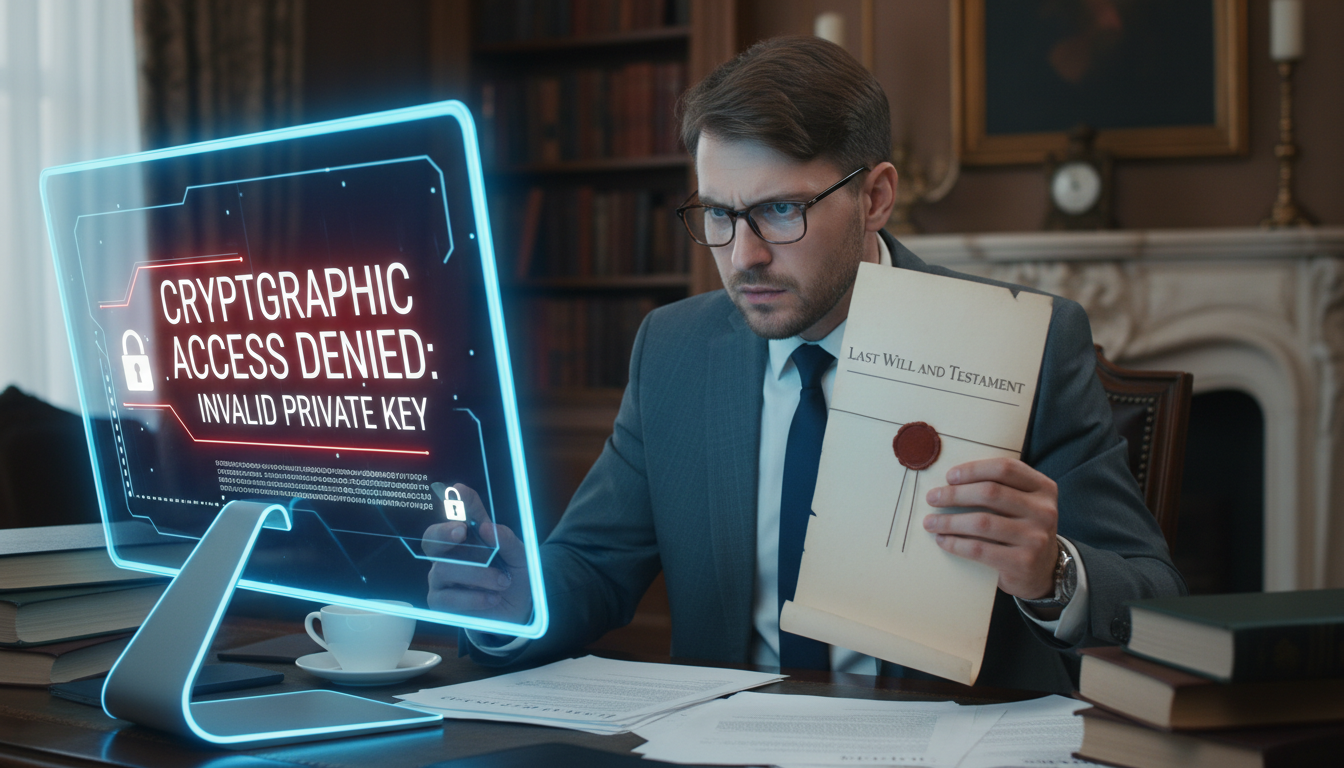
To truly understand the operational friction between legacy legal systems and modern access management, we must examine the failure cascade inherent in traditional estate planning. Consider the fictionalized yet highly representative estate of a proactive investor named Alex. At thirty-five, Alex ran a successful independent software agency and had strategically invested in cryptocurrency for over a decade, accumulating a diverse and highly valuable portfolio of Bitcoin and decentralized finance assets. Recognizing the inherent value of this fragmented digital ecosystem, Alex executed a traditional, attorney-drafted Last Will and Testament, leaving "all residual assets, both physical and digital" to their sole sibling.
When Alex suffered an unexpected, fatal medical emergency, the physical components of the estate transitioned efficiently. The sibling utilized the probate court documents to legally assume control of Alex's house, physical possessions, and traditional checking accounts. However, securing the digital wealth forced a devastating operational deadlock.
The executor physically possessed Alex's laptop and a Ledger hardware wallet discovered inside a safety deposit box. But physical possession of hardware is entirely disconnected from access to the decentralized blockchain. Alex had brilliantly secured their devices against malicious theft. The laptop's solid-state drive was heavily encrypted, and the Ledger hardware wallet was safeguarded by a strict numeric PIN.
Armed only with a paper will and entirely lacking operational transition protocols, the sibling desperately attempted to guess the hardware wallet PIN using family birthdays. This blind reliance on traditional access methods triggered a catastrophic security protocol. On the third incorrect attempt, the hardware wallet automatically executed its hardcoded self-defense mechanism, initiating a permanent factory reset that instantly wiped the device's internal memory. Because the 24-word master seed phrase was hidden separately without any routing mechanism, the cryptographic bridge was immediately burned. The sibling merely inherited an empty piece of plastic, while the underlying decentralized funds transformed into missing crypto after death—mathematically visible on the public blockchain forever, yet entirely unclaimable.
The Immense Scale of Missing Crypto After Death
This resulting financial paralysis is not an isolated edge case; it is an increasingly alarming macroeconomic trend. According to blockchain analytics authority Chainalysis, approximately twenty percent of all Bitcoin ever mined has been lost entirely, representing massive reserves of inaccessible economic value. While early cryptographic losses were often attributed to accidental hardware destruction, the modern wave of stranded digital capital is overwhelmingly tied to individuals passing away without a mapped operational handover.
"If a private key is lost, the underlying decentralized network views the original asset owner not as deceased, but simply as a functioning wallet that has chosen never to transact again. The blockchain is entirely indifferent to human death."
This absolute neutrality means that immense sums of generational wealth are regularly incinerated entirely due to access management oversights. Without a proactive framework, families simply surrender to the silent erosion of their inheritance.

Regulatory Illusions: Why State Legislation Fails the Technical Test
Some fiduciaries mistakenly assume that modern legislative bodies have resolved these impasses to shield grieving families. This assumption heavily relies on the application of the Revised Uniform Fiduciary Access to Digital Assets Act (RUFADAA), a critical legal framework initially formulated by the Uniform Law Commission. Adopted by a vast majority of U.S. jurisdictions, RUFADAA definitively grants trustees, executors, and appointed fiduciaries the legal authorization to manage a deceased person's computer files, software licenses, domain registries, and virtual currencies.
However, recognizing this law is vital for understanding its most significant limitation: RUFADAA accurately solves for legal permission, but it fundamentally fails to solve for technical capability.
When a probate judge issues a binding court order authorizing an executor to penetrate a deceased's cryptocurrency exchange account or corporate cloud environment, they are merely issuing formal permission to knock on the digital door. The massive technology infrastructure companies guarding these operational environments prioritize their own stringent user Data Privacy agreements and terms of service over external state decrees. If an overarching platform policy rigorously forbids bypassing user encryption without prior, explicitly logged technical consent within the application itself, the external legal order is effectively rendered moot. Attempting unauthorized alternative access strategies without correct credentials can rapidly trigger violations under federal statutes like the Computer Fraud and Abuse Act (CFAA).
Comparing Traditional Probate and Digital Ecosystem Finality
The disparity between managing tangible property and securing an online inheritance demands a radical recalibration of succession expectations. The structural boundaries present in cryptocurrency operations strip away all historical safety nets afforded to analog executors.
| Transfer Variable | Traditional Assets (Real Estate, Banks) | Digital Assets (On-Chain, Cloud, Web) |
|---|---|---|
| Executor Authority Core | Automatically established by Last Will & Probate Court | Dictated entirely by operational software credentials |
| Recovery Failsafe Mechanism | Transfers to State Unclaimed Property Divisions | None. Cryptographic finality results in irreversible wipeouts. |
| Authentication Overrides | Local banks will manually override offline accounts upon verified demise | Platforms inherently rely on rigid 2FA barriers and biometric reliance |
| Primary Operational Threat | Complex taxation, probate scheduling, and familial legal disputes | Total systemic lockout and permanent capital trapping |
Overlooked Constraints: The Brick Wall of Multi-Factor Authentication
The most brutal, yet frequently underestimated operational hurdle involves the inescapable bottleneck of Multi-Factor Authentication networks. To visualize this friction, imagine a recurring scenario faced by estate administrators: A mourning parent attempts to recover their late daughter’s primary administrative email address to salvage vital tax documents and unclaimable digital wealth coordinates. Relying on a master notebook found on a desk, they successfully enter the correct master password into the login interface.
The parent feels a temporary wave of relief, yet instantly, the login screen redirects to a secondary security challenge, demanding a Time-based One-Time Password (TOTP) retrieved from an authenticator app, or alternatively, an SMS verification ping. Unfortunately, during the immediate, chaotic financial reorganization following the funeral, a well-meaning family member officially canceled the deceased's cellular plan to preserve estate funds. The underlying mobile phone number was subsequently deactivated and recycled, deliberately severing the designated authentication tether.
The parent is immediately trapped in a self-contained paradox. They possess the legitimate password, they retain the authorized legal right of representation, but they critically lack the real-time secondary network validation that automated infrastructure relentlessly demands. The core email account—and therefore every interconnected digital investment asset linked to its recovery protocol—is permanently dead-ended.
Unforeseen Cascading Triggers
- Auto-Renewing Subscriptions: Cloud servers continuously drain fiat estate accounts while backend credentials remain technically lost, draining wealth rapidly.
- Sub-Domain Expiration: Profitable digital businesses automatically vanish overnight when associated renewal emails fail to alert the disabled executor.
- Regulatory Freezes: International cryptocurrency nodes will permanently suspend assets if mandatory geographic identity compliance regulations are not re-signed by the estate dynamically.
- Biometric Dependency Fails: Devices entirely reliant on localized Touch ID or integrated facial recognition sensors cease functioning entirely upon biological death, permanently boxing out fiduciaries.
The Fatal Mistakes in Digital Asset Succession
Failing to isolate your digital continuity strategy from your analog legal framework is exceptionally dangerous. Executors repeatedly encounter compromised security parameters because asset holders relied on fundamentally flawed assumptions regarding wealth transition mechanics.
- Treating a Last Will as a Password Manager: Individuals mistakenly insert private keys or sensitive passwords directly into their official estate planning documents. Because a traditional Last Will is rapidly filed into public probate records, those confidential asset coordinates become immediately readable by the general public, exposing the entire digital portfolio to immediate theft.
- The Illusion of Joint Portfolios: Believing that appending a spouse to a joint domestic checking account inherently transfers overriding authority to distinct individual digital portfolios or isolated cryptocurrency applications.
- The "Scrap Paper" Trap: Meticulously hiding a fragmented seed phrase deeply inside an unmarked paperback book resting on a shelf. Upon liquidation of the physical estate, well-meaning heirs frequently donate or discard the book, completely incinerating their inheritance mechanism.
- Assuming Administrative Flexibility: Believing that submitting a verified death certificate to a decentralized exchange customer support email will automatically trigger a manual vault override sequence.
An Operational Framework for Seamless Digital Succession
How do proactive investors successfully bypass these extensive technological barriers? The solution requires purposefully decoupling asset access from the biological limitations of the asset holder. We must construct an automated contingency apparatus capable of executing precision deliverables.
- Map the Decoupled Infrastructure: Identify precisely where the unclaimable digital wealth actually resides, tracing all isolated decentralized endpoints, cloud dependencies, and active authentication bottlenecks.
- Isolate Cryptographic Secrets: Segregate all master passwords, secondary recovery keys, and vital instructional mandates away from localized, vulnerable hardware components into an autonomous environment.
- Establish Secondary Fiduciary Operations: Appoint a specialized digital executor specifically chosen for their profound technical competence under precise RUFADAA alignment boundaries.
- Automate Condition-Based Routing Protocols: Utilize dedicated succession software precisely designed to silently initiate the cryptographic handover precisely upon detecting verified user incapacitation.
To properly execute this secure architecture without friction, modern fiduciaries rely on specialized infrastructure tools. Acting as an intelligent safety net, Cipherwill bridges the fatal gap between physical disruption and digital continuity. Instead of forcing critical private keys onto vulnerable paper trails or forcing grieving families into convoluted probate negotiations, proactive asset holders utilize Cipherwill to encrypt and organize their critical legacy payload into an autonomous monitoring module.
Through rigorous operational design, systems like an automated dead man's switch effectively monitor a user's consistent online heartbeat. If the platform registers sudden inactivity indicative of a worst-case scenario, the system validates the absence objectively. Then, relying on zero-knowledge time capsule encryption, it automatically delegates and transmits the operational credentials securely to predefined internal beneficiaries. There is no guessing for the executor, zero reliance on external hardware integrity, and the overarching threat of lost digital assets after death is entirely neutralized. The unclaimable digital wealth is legally seamlessly transitioned.
The Proactive Digital Legacy Checklist
Ensuring successful transition involves aggressive preemptive structuring. Use this immediate checklist to stabilize vulnerabilities.
- [ ] Defragment the Ecosystem: Intentionally catalog every decentralized cold wallet mapping, dynamic hot wallet extension, primary exchange ledger, and independent digital storefront pipeline into a synchronized master registry.
- [ ] Analyze 2FA Dependencies: Rigorously trace all associated backup codes and time-based authenticator requirements linked definitively to your single-point-of-failure primary communicative email account.
- [ ] Formalize Fiduciary Authorization: Legally update legacy estate planning directives to encompass explicit RUFADAA-compliant digital authorizations tailored strictly for designated technological fiduciaries.
- [ ] Implement Automated Contingency Architecture: Securely anchor all vital transfer documentation and overriding cryptographic credentials within automated dead man's switch software networks guaranteeing seamless beneficiary handover.
Frequently Asked Questions
Question: What is considered an unclaimed digital asset?
Answer: An unclaimed digital asset is any online property, monetary account, or digital file that surviving family members cannot access after the original owner's incapacitation or death. This includes missing cryptocurrency wallets, trapped e-commerce revenue streams, abandoned cloud storage files, and inaccessible intellectual property. Without operational passwords, these assets remain mathematically permanently locked away.
Question: Can my family recover my crypto if I die without sharing the private key?
Answer: No, recovering cryptocurrency without the precise cryptographic private key or designated seed phrase is mathematically impossible due to the decentralized nature of blockchain technology. Unlike traditional banks that can bypass passwords with a death certificate, decentralized networks have no customer service departments or override capabilities to rescue permanently locked lost digital assets after death.
Question: Does the RUFADAA law automatically grant my family access to my email?
Answer: The Revised Uniform Fiduciary Access to Digital Assets Act (RUFADAA) gives your legal executor the legal right to request access, but it does not guarantee technical fulfillment. Major technology providers often deny access to private emails, citing stringent data privacy laws and terms of service, unless you explicitly provided prior operational consent or routing instructions.
Question: How does a dead man's switch prevent missing crypto after death?
Answer: A dead man's switch is an automated security mechanism that monitors a user's digital activity. If the user stops interacting with the system for a predefined time—indicating potential incapacitation or death—the switch activates. It then transparently and automatically decrypts and securely routes critical access credentials to pre-designated beneficiaries, entirely bypassing manual recovery hurdles.
Question: Should I include my digital passwords in a traditional Last Will and Testament?
Answer: You should never document sensitive passwords, private keys, or wallet seed phrases in a traditional Last Will and Testament. Once submitted to a probate court, a traditional will becomes a matter of public record. Anyone can read the document, exposing your entire digital estate to theft long before your rightful beneficiaries secure the assets.
Question: What happens to 2FA locked accounts when the owner dies?
Answer: Without a comprehensive transition procedure, two-factor authentication (2FA) acts as an insurmountable barricade. If an executor possesses the correct password but cannot intercept a real-time SMS code or access a physical biometric authenticator device because the mobile network was deactivated, the associated wealth becomes permanently trapped unclaimable digital wealth inside the ecosystem.
Question: What is digital asset fragmentation and why is it problematic for executors?
Answer: Digital asset fragmentation occurs when a person's internet wealth is dispersed across dozens of non-integrated entities, such as independent crypto exchanges, secondary cloud servers, and decentralized smart contracts. This extreme decentralization forces executors to embark on an impossible forensic scavenger hunt, often leading to massive financial losses because they simply do not know where to search.
Question: How long does cryptocurrency stay on the blockchain if lost?
Answer: Missing crypto after death remains actively recorded on the decentralized public blockchain ledger forever. The immutable nature of cryptographic networks means abandoned digital coins do not degrade or expire. However, without the precise operational private key required to authorize a blockchain transfer, the underlying monetary value is permanently frozen and utterly unusable by anyone.
Question: Can a tech company legally delete my accounts after I pass away?
Answer: Yes, many technology tier companies institute strict inactivity protocols detailed deep within their user terms of service. If an account remains completely dormant for an extended period, the provider may automatically delete the data repositories to save server capacity. This wipes out family histories, vital software licenses, and access gateways to unclaimable digital wealth irreversibly.
Question: How does digital inheritance software differ from a standard password manager?
Answer: Standard password managers are designed strictly for the living, actively requiring master biometric authentication to unlock. In contrast, dedicated digital inheritance platforms are uniquely engineered for authorized posthumous transfer. They utilize automated condition-based routing protocols that recognize an owner's absence and subsequently decrypt and disseminate the access credentials to legal fiduciaries logically and automatically.
By Cipherwill Editorial Team, Reviewed by Cipherwill Review Board, Trust & Security Review Team
Editorial contributor: Iraan Qureshi
Review contributor: Nivaan Khattar