
The Invisible Thread of Intent
The most flawless tax-free inheritance strategies fail not because of poor legal drafting, but because of sudden heir panic. If an estate holds highly appreciated, long-term assets—specifically Qualified Opportunity Funds (QOFs) operating under Internal Revenue Code Section 1400Z-2—liquidating them prematurely destroys their primary financial benefit. When a wealth creator passes away mid-hold, beneficiaries inherit the original holding period intact across the generational divide. However, if those heirs lack operational context and sell out of fear during market volatility, they forfeit the ultimate 10-year basis step-up. This miscalculation transforms a completely tax-free generational transfer into a catastrophic federal tax liability. Successful legacy protection requires passing down the exact strategic conditions of the hold, not simply the legal title to the asset.
Financial infrastructure is ultimately managed by humans, subjected to raw psychological stress during times of mourning. Transferring wealth without structural context is like handing over the controls of a complex aircraft in mid-flight without an instructional manual. The structural integrity of multi-generational portfolios demands rigid operational knowledge transferred simultaneously with legal ownership.

The Tragedy of Incomplete Transfer: A Case Study
Consider the operational reality of Marcus, a second-generation commercial developer operating a family office out of Texas. Marcus sat in his private office in late 2018, signing the final paperwork to roll $4 million of recognized capital gains into a meticulously vetted private Qualified Opportunity Fund. His strategy was structurally perfect. By utilizing the mandated holding rules, he was shielding a massive future fortune for his three children. Under the law, if the investment was held for a full decade, any capital appreciation upon disposition would be entirely tax-free. He filed the operating agreements in his private cabinet, confident his estate attorney had secured their future.
Fast forward exactly eight years. Marcus passes away suddenly. The commercial real estate market is enduring a brutal, high-interest rate contraction, and his portfolio's internal valuations are fluctuating wildly. His three children, sitting around an oak conference table facing a mountain of complex K-1 tax forms, feel the crushing weight of illiquid, opaque assets. A mainstream financial broker, eager to reallocate their newly inherited capital into mathematically simpler, fee-generating equities, advises them to liquidate the fund immediately to realize the capital.
Ignorant of the remaining two-year requirement to secure the final step-up in basis, and panicked by the sheer complexity of the underlying asset class, the heirs authorize the sale. By selling in year eight, they abandon millions of dollars in completely tax-free appreciation, instead triggering a massive, immediate capital gains event that decimates the portfolio's generational purchasing power.
"Generational wealth is rarely destroyed by the market. It is almost exclusively dismantled by a lack of internal communication and operational continuity during moments of intense family grief."
The 10-Year Step-Up: When IRS Rules Meet Emotional Reality
To comprehend the severity of heir panic selling, one must understand the precise mechanical advantages granted by the federal tax code. The Opportunity Zone program, established under 26 U.S. Code § 1400Z–2, offers unprecedented incentives for long-term capitalization. Investors who reinvest eligible capital gains into a QOF can defer the original tax liability, reduce that original liability if held for a specific duration, and, crucially, eliminate all capital gains tax on the new investment if held for 10 years.
Unlike standard investments that undergo a traditional basis step-up upon the death of the owner, a QOF asset transfer to an heir is not considered an inclusion event. Instead, the Internal Revenue Service guidelines mandate that the beneficiary "steps into the shoes" of the decedent. The holding clock does not reset; it continues to tick toward that decade milestone. If the parent held the asset for seven years, the heir only needs to maintain the holding profile for three more years to unlock the ultimate federal tax exemption on the asset's total appreciation.
This legal mechanism is a profound wealth preserver. However, the federal government does not enforce patience. The Treasury Department framework allows for secondary market liquidations or early exits by beneficiaries who feel overwhelmed by the compliance burden. The intersection of highly complex tax code and the raw emotional exhaustion of the probate process creates the perfect storm for disastrous financial decision-making.
Phantom Income: The Operational Catalyst for Panic
One of the most uncommon risks in multi-generational wealth transfer is the sudden occurrence of "phantom income." Family offices and high-net-worth developers frequently invest in private equity structures organized as pass-through entities. In a pass-through entity, tax liabilities flow directly to the investors via Schedule K-1 forms, regardless of whether the fund distributed actual liquid cash that year.
If beneficiaries inherit a complex fund, they may suddenly receive a K-1 documenting hundreds of thousands of dollars in taxable income, yet their checking accounts receive no distribution to cover that exact tax bill. This is phantom income. Confronted with a six-figure IRS liability out of nowhere and lacking the historical context of why this investment structure is ultimately beneficial, heirs panic. They look at the illiquid holding as a toxic liability rather than a long-term golden goose, prompting rapid, deeply discounted secondary market sales just to cover the tax hit.
Comparing the Cost: Intentional Holding vs. Blind Inheritance
The mathematical disparity between retaining an asset through the required technical period versus liquidating early due to unguided fear is absolute. Below is a realistic comparison of a $4 Million initial capital gain reinvestment into a qualifying long-term fund that appreciates to $10 Million at the time of the investor's passing in Year 8.
| Operational Decision Variable | Strategy A: Informed Heir (Holds to Year 10) | Strategy B: Panicked Heir (Sells in Year 8) |
|---|---|---|
| Treatment of $6M Appreciation | Steps up to Fair Market Value upon exit, fully tax-free. | Fully recognizable as taxable capital gains immediately. |
| Deferred Inclusion Tax (2026 cliff) | Paid from strategic reserves as originally planned by the estate. | Accelerated and compounded by the premature asset sale. |
| Estimated Federal Tax Burden | $0 on the massive portfolio growth segment. | Excess of $1.2 Million (assuming strict 20% federal capital gains). |
| Intergenerational Capital Retained | Maximized, preserving full purchasing power. | Severely degraded through administrative and tax friction. |
Common Mistakes That Devastate Generational Wealth
The sheer mechanics of the psychology of wealth transfer demonstrate that technical trusts and wills only outline 'who' receives the asset, completely failing to address 'how' and 'why' the asset should be managed. Consider these prevalent oversights:
- Relying exclusively on the legal text of a trust: A robust trust will distribute the asset securely, but a legal instrument does not calm a grieving beneficiary facing down market volatility. Trusts distribute capital; they rarely distribute operational reassurance.
- Failing to properly map tax inclusion events: Leaving heirs blind to deferred tax triggers, specifically the looming statutory recognition of deferred QOZ gains, ensures panic when the bill arrives without corresponding cash distributions.
- The assumption of continuous external advisory: Wealth creators often assume their hand-picked CPA or wealth advisor will successfully mandate asset retention to the heirs. However, heirs frequently sever relationships with their parents' advisors, preferring their own contacts who may inadvertently recommend catastrophic portfolio overhauls.
- Ignoring the psychological weight of illiquidity: Next-generation heirs are conditioned for digital liquidity. If an asset cannot be materialized instantly, it is often viewed as a threat rather than a safeguard. This friction inevitably spurs rash decision-making.
The Operational Framework for Stealth Wealth Transfer
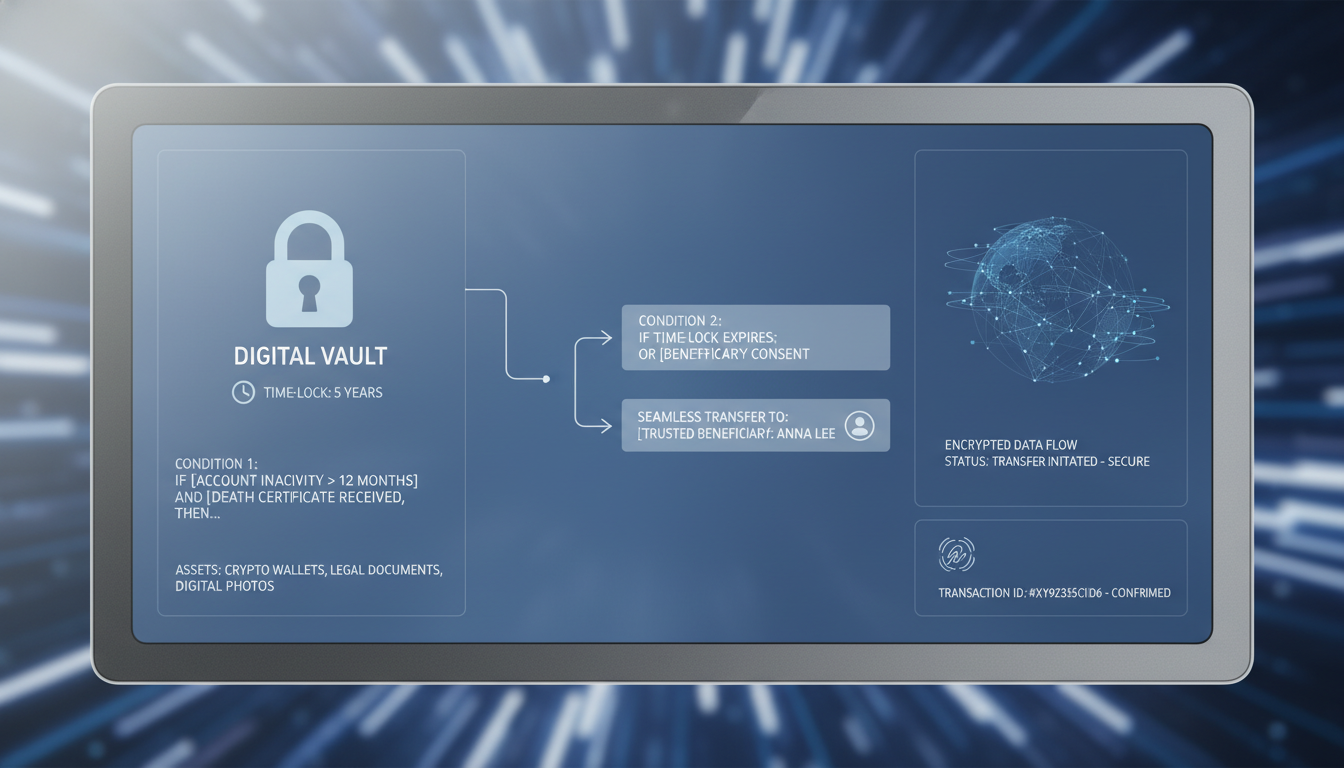
Solving the inheritance knowledge crisis requires moving beyond stagnant paper documentation and adopting conditional logic platforms that bridge the gap between asset ownership and asset execution. To prevent fear-based liquidations, you must implement a system that systematically educates beneficiaries using time-locked delivery parameters right when they inherit.
This is where platforms like Cipherwill provide a mandatory missing link for estate planners. Cipherwill does not merely exist to move a seed phrase or banking credential from Point A to Point B; it acts as a cryptographic vault for the underlying operational instruction manual. By utilizing a secure dead man's switch, a wealth creator can stipulate conditional release mandates. If the estate owner passes away, their beneficiaries do not just receive the complex fund allocation; they simultaneously unlock a secure, authenticated directive detailing the 10-year holding requirement, the anticipated phantom income mechanics, and explicit protocols detailing why the asset must remain untouched to realize its tax-free shield.
By shifting the paradigm from 'passing down assets' to 'passing down the governance framework,' the wealth creator insulates their life's work against the corrosive effects of external market fear and internal family discord.
The Succession Action Checklist
Proper execution of a 10-year hold across generations demands a strict operational plan. Ensure your estate is immunized against panic selling by verifying the following actionable protocols:
- Calculate the precise dates for all timeline-dependent assets, marking the exact month and year the final step-up in basis is unlocked under federal law.
- Draft a plain-English Letter of Intent detailing why these assets are intentionally illiquid, specifically addressing potential phantom income tax burdens and structural market volatility.
- Secure these directives inside a cryptographically secure digital succession vault capable of automated execution upon death verification.
- Mandate a mandatory introduction between your designated beneficiaries and the specific tax professionals managing the K-1 schedules of the underlying opportunity funds.
- Establish dedicated liquid reserves within the estate explicitly earmarked to cover any deferred capital gains inclusion taxes, eliminating the need for beneficiaries to sell assets to pay the Treasury.
Frequently Asked Questions
Question: What is the 10-year rule for Qualified Opportunity Funds?
Answer: Under IRC Section 1400Z-2, taxpayers who invest eligible capital gains into a Qualified Opportunity Fund and hold the investment for at least 10 years are granted a step-up in basis to fair market value. This effectively eliminates federal capital gains taxes on all appreciation realized during that decade of growth.
Question: What happens if I inherit a QOF before the 10-year holding period ends?
Answer: You "step into the shoes" of the decedent. The holding period does not reset upon the death of the original investor. If the original owner held the asset for eight years, the heir only needs to maintain the investment for two additional years to secure the full tax-free exit.
Question: Does the death of a QOF investor trigger a taxable inclusion event?
Answer: No, the transfer of a QOF interest by reason of death to an estate or designated beneficiary is explicitly excluded from being treated as a taxable inclusion event. The deferred tax obligations and the timeline strictly transfer over to the inheriting party intact.
Question: Why do heirs frequently panic sell inherited private funds?
Answer: Heirs often sell prematurely because they inherit the complex asset without the underlying knowledge strategy. Confronted by fluctuating valuations, illiquidity constraints, and the sudden arrival of complex tax forms like Schedule K-1s, beneficiaries prioritize immediate cash liquidity over mathematically superior, tax-shielded long-term gains.
Question: What is phantom income in the context of an inheritance?
Answer: Phantom income occurs when a pass-through entity, such as a private equity fund or QOF, reports taxable income to investors on a K-1 form but does not distribute actual liquid cash to pay the resulting tax liability. This dynamic frequently forces panicked heirs to sell assets prematurely.
Question: How can a digital succession platform prevent panic selling?
Answer: Digital succession platforms use conditional logic to transfer operational knowledge precisely when legal inheritance occurs. Instead of handing heirs an opaque legal trust, they receive time-locked, secured digital instructions explicitly detailing the holding strategy and financial calculations, effectively calming market fears.
Question: Is QOF tax deferral automatically transferred to the beneficiary?
Answer: Yes, the initial tax deferral status is transferred. However, the beneficiary will ultimately be liable for recognizing the deferred capital gains tax on the original inclusion date (historically targeted as December 31, 2026), meaning continuous strategic planning is legally vital across generations.
Question: What is a step-up in basis regarding generational wealth transfer?
Answer: A step-up in basis adjusts the value of an inherited asset to its current fair market value upon the original owner's death. This eliminates capital gains tax on historical appreciation. In QOFs, a similar ultimate step-up is granted only after a rigid 10-year holding period is satisfied.
Question: Can a trust agreement prevent an heir from selling an asset?
Answer: A trust can impose legal constraints and appoint independent trustees to govern liquidation, but restrictive trusts can cause deep family friction. Providing absolute educational clarity and structural context via a conditional vault is often more effective at maintaining family unity and asset retention than rigid, blind legal mandates.
Question: Why are K-1 tax forms a major risk factor during probate?
Answer: Schedule K-1 forms arrive in the spring following the tax year, often months after an estate undergoes probate. Their arrival reveals complex partnership tax liabilities that heirs are usually unprepared to manage administratively or financially, triggering a widespread impulse to liquidate the originating asset completely.
By Cipherwill Editorial Team, Reviewed by Cipherwill Review Board, Trust & Security Review Team
Editorial contributor: Myra Senapati
Review contributor: Tavish Bhonsle