Over 20% of all mined Bitcoin is permanently lost, leaving behind a $100 billion digital graveyard. According to blockchain analytics firm Chainalysis, this staggering financial tragedy stems largely from a singular modern failure: the absence of robust crypto inheritance planning. If you hold decentralized assets, understanding how to securely transfer your private keys to beneficiaries is not just an administrative chore—it is a critical requirement for digital wealth preservation.
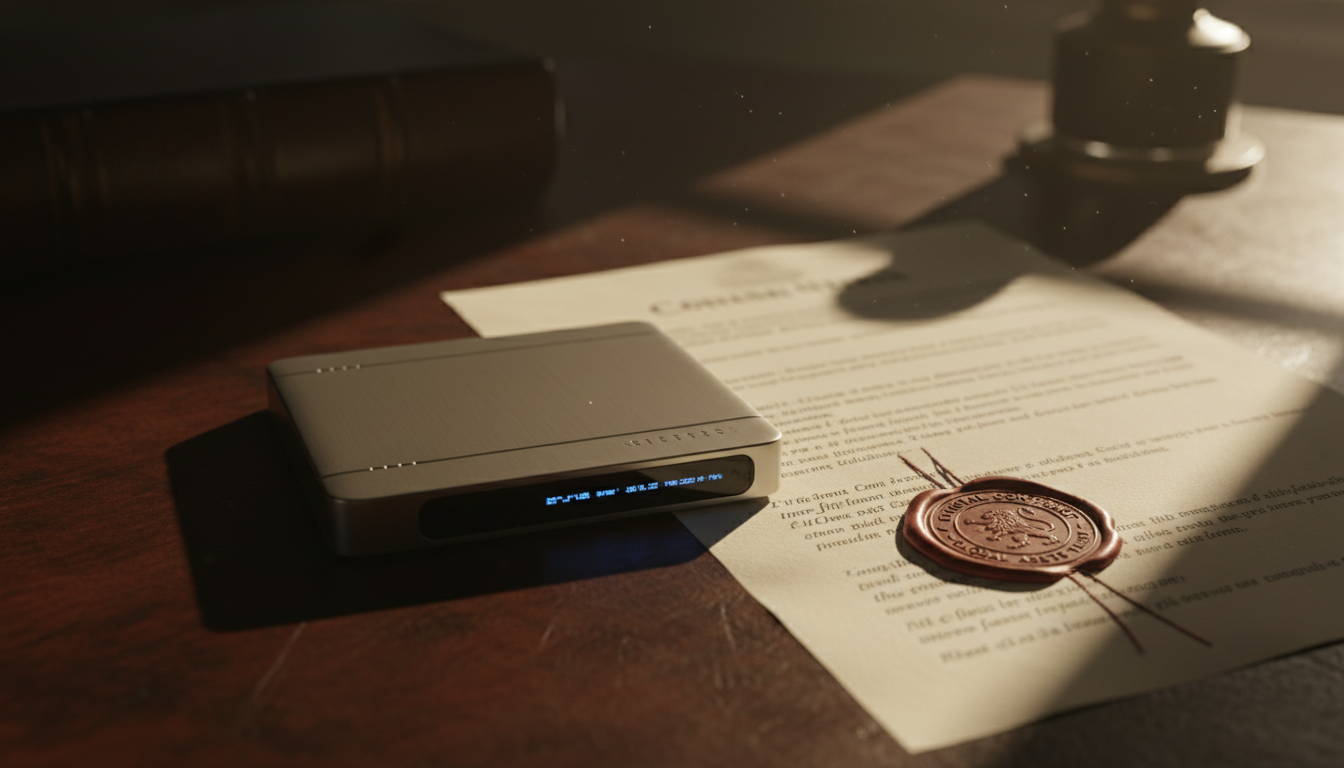
A conventional estate plan cannot mathematically unlock a hardware wallet. Traditional legal documents were built for centralized institutions that obey court orders, not decentralized networks that obey only cryptography. When a crypto holder passes away without an engineered succession plan, they trigger an irreversible sequence of events that usually ends with generational wealth vanishing into the cryptographic void.

The Anatomy of a Mathematical Tragedy
Consider the real, operational constraints of cryptographic security. Marcus, a 45-year-old software engineer, spent seven years steadily accumulating a substantial Bitcoin portfolio. He prioritized security above all else, utilizing a state-of-the-art hardware wallet locked in a fireproof safe. When Marcus passed away unexpectedly, his wife, Elena, found the device alongside a legally binding last will and testament that explicitly granted her full ownership of all his digital assets.
But legal ownership is an illusion on the blockchain. Elena found a small notebook with partial instructions and a four-digit PIN code. What Marcus failed to explain in his documentation was that his specific hardware device featured a ruthless brute-force protection mechanism. After a moment of hesitation, Elena entered the PIN she found. It was rejected. She tried a variation of his birth year. Rejected again. Unbeknownst to her, entering a third incorrect PIN triggered the device’s self-destruct protocol. The hardware wallet wiped its memory entirely.
Because Marcus had not established a secure seed phrase recovery protocol, and had instead relied on vague notes, nearly a decade of saving evaporated in a matter of seconds. This scenario plays out globally on a daily basis, highlighting why technical contingencies must supersede traditional assumptions.
The Legal Illusion: Probate Courts vs. Cryptography
One of the most dangerous digital estate mistakes is assuming that a judge's signature can compel the blockchain to surrender funds. Many traditional estate attorneys point out that state laws now include provisions for digital assets. For instance, the Revised Uniform Fiduciary Access to Digital Assets Act (RUFADAA) gives legally appointed executors the right to manage an individual's digital property.
However, RUFADAA only forces compliance from centralized custodians—such as social media networks, email providers, or centralized financial applications. If your assets are self-custodied on a decentralized protocol, no legal entity on Earth can bypass the mathematics of elliptic curve cryptography. The blockchain does not possess an IT support desk. There is no central authority to review a death certificate or a letter testamentary.
This legal illusion sets families up for catastrophic failure. Picture a grieving family sitting in a probate court, receiving official documentation that grants them authority over a decentralized cryptocurrency trust. They eagerly take that court order and attempt to present it to a decentralized autonomous organization (DAO), only to realize the network relies strictly on cryptographic key signatures. The court order is technically worthless without the private key.
Comparing Asset Storage Locations
Navigating this landscape requires understanding exactly where your assets are physically and digitally located. Legacy transition mechanics change entirely based on where the capital sits at the moment of your passing.
| Asset Custody Type | Inheritance Mechanism upon Death |
|---|---|
| Centralized Exchanges (CEX) | Requires death certificate, full legal probate process, and letters testamentary. Subject to massive legal delays, but technically recoverable. |
| Hardware Wallets (Self-Custody) | Requires physical access to the device and the correct PIN, or access to the 12/24-word seed phrase. No external legal bypass exists. |
| Multi-Signature (Multi-Sig) Wallets | Requires coordination between designated key holders (e.g., 2-of-3 signatures). An automated or manual legal handoff controls key execution. |
Common Digital Estate Mistakes
The operational reality of managing cryptographic keys is fraught with human error. The National Institute of Standards and Technology (NIST) emphasizes that robust cryptographic key management requires minimizing physical and digital exposure vectors. Unfortunately, isolated token holders invent highly flawed inheritance methods.
- The Public Will Exposure: Embedding your actual seed phrase or explicit location instructions inside your last will. Once filed in probate, wills become public records, meaning anyone parsing the court filings could sweep your wallets before your family even gains access to them.
- The Do-It-Yourself Puzzle: Attempting pseudo-Shamir's Secret Sharing by physically tearing a paper seed phrase in half and hiding the pieces in different geographic locations. If one piece is lost to water damage, mold, or simply being misplaced, your entire net worth is rendered inaccessible.
- The Cloud Convenience Failure: Saving recovery phrases on Google Drive, Apple iCloud, or an unencrypted digital notepad in a password manager. A sudden death allows time for bad actors to target poorly secured cloud accounts, completely bypassing your intended beneficiaries.
- The Over-Delegation Risk: Handing absolute, unilateral control of your seed phrase to a traditional attorney while you are still alive. Law firms suffer data breaches regularly, and individual practitioners may lack the technical cybersecurity hygiene required to safeguard volatile digital wealth.
The Cryptographic Inheritance Framework
To achieve true digital wealth preservation, holders must shift from a mindset of absolute secrecy to a mindset of conditional execution. You need a system that assumes you will not be there to clarify instructions, but actively protects the assets from insider threats while you are alive.
This introduces the concept of a dead man's switch architecture mapped tightly to robust zero-knowledge encryption principles. Instead of trusting purely physical locations or third-party law firms, HNWIs and thoughtful crypto investors utilize time-locked encryption environments that only decrypt data for predetermined beneficiaries upon verification of unresponsiveness.
Operational Hierarchy to Secure Your Legacy
- Consolidate Asset Inventories: Document exactly what assets exist and on which networks they reside. Avoid listing actual keys; state only the locations (e.g., "Ledger hardware wallet in the specific home safe").
- Establish Verifiable Check-ins: Employ an encrypted digital inheritance platform that requires you to actively verify your living status at regular intervals (a biological ping).
- Layer Conditional Encryption: Secure actual private keys or seed phrases behind zero-knowledge encryption protocols that are intrinsically mathematically linked to the unresponsiveness trigger.
- Appoint Trusted Executors: Clearly designate specific beneficiaries who receive the decryption keys only when the operational check-ins fail and the specified time-delay executes.
- Conduct a Dry Run: Have your assigned executor manually review the instructional guidelines without explicitly requesting access to the vaulted keys, ensuring they understand the recovery sequence.
Closing The Execution Gap
Families frequently underestimate the sheer psychological toll of navigating complex cryptographic recovery during deep periods of grief. When you remove ambiguity from the equation, you eliminate panic. Implementing these systems correctly means adopting reliable infrastructure. The deployment of a digital inheritance platform like Cipherwill bridges the fatal gap between estate law and mathematical truth.
Cipherwill utilizes time-capsule encryption to guarantee that your most sensitive credentials and operational instructions remain completely inaccessible—even to the platform itself—until your designated conditions are met. It ensures your beneficiaries receive exactly the right technical access precisely when they need it, removing the immense burden of guesswork from their shoulders.
Do not let a lifetime of conviction and disciplined investment become a permanent contribution to the blockchain graveyard. An airtight crypto estate plan separates responsible digital wealth preservation from devastating structural loss.
Strategic Checklist for Your Digital Estate
"If your family has to search for it, or guess a password, you do not have an inheritance plan; you have a digital treasure hunt with catastrophic consequences."
- Verify that your traditional will mentions digital assets abstractly without exposing actual seed phrase material.
- Store your physical recovery keys in environmentally controlled, durable formats (such as stamped titanium plates).
- Set up an automated dead man's switch to trigger the release of operational instructions if you are unexpectedly incapacitated.
- Ensure your designated executor actually understands the distinction between centralized crypto exchanges and decentralized hardware wallets.
- Update your asset inventory immediately after migrating funds across new blockchain ecosystems.
Frequently Asked Questions
Question: Why can't I just put my seed phrase inside my standard last will and testament?
Answer: Traditional wills become entirely public records during the probate pipeline. If you include your seed phrase directly in the document, anyone who reviews the public court filings can sweep your wallets long before your grieving family is granted authorized legal clearance.
Question: Will an estate lawyer be able to retrieve my lost Bitcoin through the court system?
Answer: No. Decentralized assets rely purely on cryptographic keys, not legal compliance. While a lawyer can help establish legal ownership of the funds, they have zero technical capability to force a blockchain to send funds without the exact private key.
Question: How exactly does a digital dead man's switch operate for crypto assets?
Answer: A dead man's switch is an automated security mechanism requiring you to verify you are alive through periodic interactions. If you fail to respond within a time threshold, the system automatically decrypts and delivers your pre-configured instructions and access codes to chosen beneficiaries.
Question: What happens to a hardware wallet if my family tries guessing the PIN?
Answer: Most industry-standard hardware wallets implement self-destruct security parameters to prevent brute-force attacks. Commonly, entering the wrong physical PIN code three to ten consecutive times will aggressively wipe the internal memory, absolutely requiring your 24-word seed phrase string for recovery.
Question: Is it safe to divide my 24-word seed phrase in half to split between family members?
Answer: No, this DIY approach is mathematically dangerous. It drastically lowers the entropy and operational security of your wallet while compounding the physical risk of loss. True decentralized splits should only rely on cryptographically enforced protocols like Shamir's Secret Sharing.
Question: Does the RUFADAA framework solve the crypto succession problem completely?
Answer: Not for decentralized assets. RUFADAA successfully empowers executors to manage digital profiles held by centralized tech companies, but it cannot compel an unhosted, self-custody wallet to authorize a blockchain transaction without the cryptographic password string attached.
Question: Can centralized platforms like Coinbase freeze my legacy funds indefinitely?
Answer: Centralized exchanges will immediately freeze your operational account upon learning of your passing. The funds are not ultimately lost, but they are completely locked behind prolonged probate procedures, forcing your family to navigate slow, frustrating institutional compliance delays.
By Cipherwill Editorial Team, Reviewed by Cipherwill Review Board, Trust & Security Review Team
Editorial contributor: Vedant Kulshreshtha
Review contributor: Reyansh Mehta