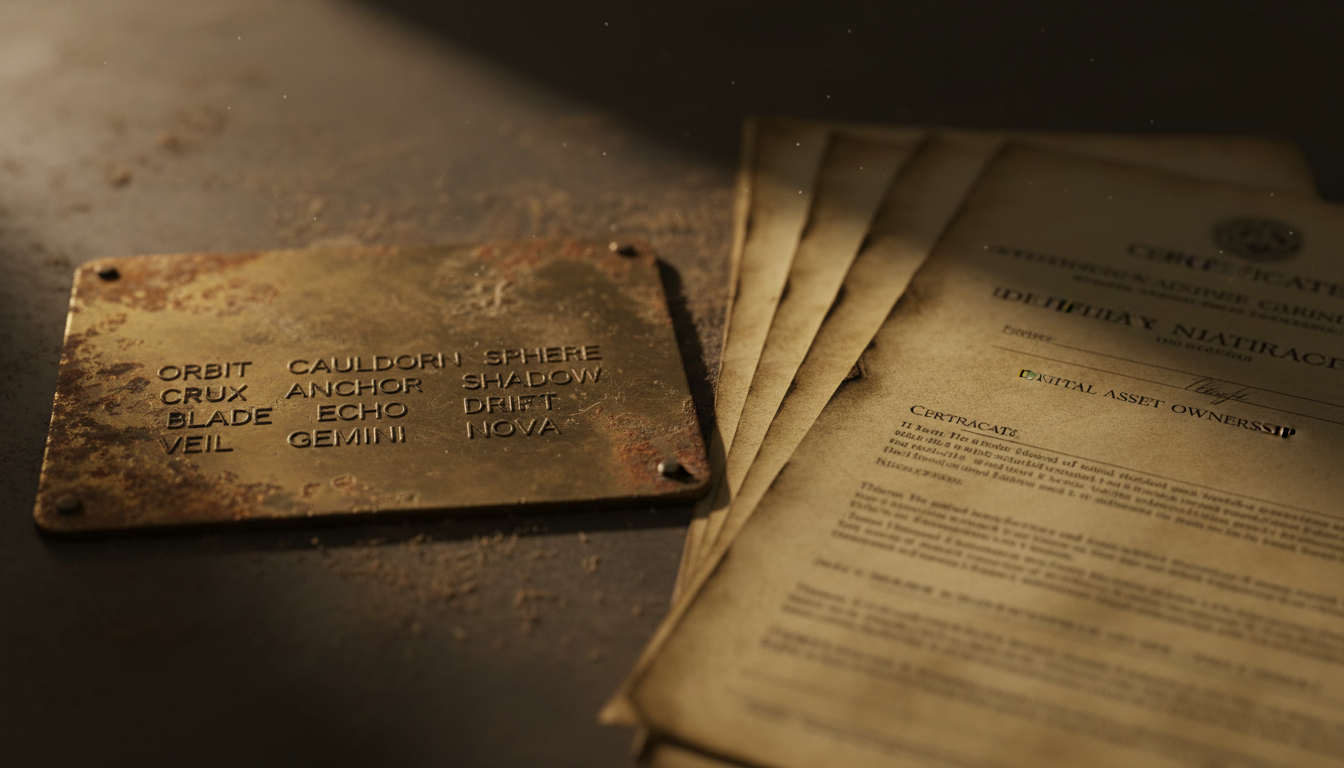
According to forensic research by Chainalysis, approximately 3.79 million Bitcoin, representing nearly 20% of the entire capped supply, are lost forever. While early misplacements account for some of this attrition, a growing wave of permanent wealth destruction stems from a single, deeply human failure point: poor crypto inheritance planning. If you hold self-custody digital assets, the methodology required to securely transfer that wealth is fundamentally different from traditional estate planning. Relying purely on physical paper backups or standard wills guarantees your wealth is exposed to theft, decay, or complete beneficiary confusion.
The transition of cryptographic keys from one generation to the next requires more than simply writing 24 words on a piece of paper or stamping them into a titanium plate. It demands an encrypted continuity framework that grants access only when necessary, shielding your assets from insider threats during your lifetime while ensuring seamless execution upon your death.

The Fallacy of the Metal Plate: A Generational Trap
Consider Marcus, a 34-year-old high-net-worth investor who rigidly adheres to the ethos of self-custody. Believing he has fully secured his family's future, Marcus spends an evening in his garage carefully stamping his BIP39 seed phrase onto an indestructible titanium plate. Under the harsh glow of a single overhead bulb, he seals the metal sheet inside a fireproof floor safe. Because the prevailing wisdom in the crypto community is to "never share your private keys," he tells no one the combination to the safe, assuming his traditional will—which generally bequeaths his estate to his sister, Elena—will suffice.
When Marcus passes away unexpectedly a year later, the structural integrity of his plan collapses instantly against operational reality.
Months into the probate process, Elena finally gains access to the safe. She holds the metal plate bearing 24 random dictionary words. Having no technical background, she does not know what a BIP39 derivation path is. She does not know Marcus utilized a 25th-word passphrase that he strictly memorized and never wrote down. Seeking help to decipher the enigmatic metal sheet, Elena mistakenly types the words into a malicious "recovery" website she finds searching online forums. Within three seconds, Marcus's entire digital legacy is swept into an automated drainer contract, gone forever.
Marcus’s story highlights an overlooked operational reality: a perfectly secure cryptographic key is entirely useless if the beneficiary lacks the exact operational context required to use it safely. Security measures designed strictly to keep adversaries out often act as impenetrable walls that keep rightful heirs out as well.
Why Traditional Estate Law Fails Cryptography
Traditional estate planning was built for centralized custodial systems. When a traditional bank account holder dies, an executor presents a death certificate and letters testamentary to a bank manager. The bank complies with the law, overrides the deceased's passwords, and transfers the funds.
The decentralized nature of blockchain neutralizes this legal mechanism completely. To bridge this gap, modern legislation has attempted to adapt. For instance, the Revised Uniform Fiduciary Access to Digital Assets Act (RUFADAA), enacted in the majority of U.S. states, grants executors the legal authority to access and manage a deceased person's digital real estate. Inheriting digital assets under RUFADAA means an executor can compel platforms like centralized crypto exchanges to hand over custody of an account.
However, legislation stops at the edges of the blockchain. A court order cannot compel the Bitcoin network to initiate a transaction. If assets are held in self-custody hardware wallets, RUFADAA provides the legal *right* to access the funds, but it cannot provide the technical *ability*. If the private keys are inaccessible, the executor is left holding an empty legal declaration over a vault they cannot unlock.
Common Mistakes in Digital Wealth Transfer
The anxiety surrounding digital loss prompts individuals to make severe tactical errors. Attempting to balance the immediate security of their funds with the certainty of future succession, crypto owners frequently commit the following structural mistakes:
- Premature Sharing (The Insider Threat): Providing a spouse or child with immediate access to a seed phrase eliminates the death-access problem but drastically multiplies security risks. Beneficiaries might fall victim to phishing, securely mismanage the physical copy, or in adversarial family scenarios, drain the funds preemptively.
- The "Half-and-Half" Mathematical Trap: A common amateur strategy is splitting a 24-word phrase into two 12-word segments, giving one half to a trusted friend and the other to a lawyer. This mathematically devastates the entropy of the key. Knowing 12 words of a modern seed phrase allows sophisticated attackers to brute-force the remaining combination in a matter of hours.
- The Silent Passphrase: Many advanced users leverage a hidden passphrase (the so-called 25th word) to generate a decoy wallet and a primary vault. If the seed phrase is documented but the passphrase is not, heirs will recover a wallet showing zero balance, leading them to falsely conclude the assets were previously stolen or abandoned.
- Exchange Dependency: Assuming logging into a centralized exchange via saved browser passwords is sufficient. Exchanges frequently trigger mandatory 2FA or biometric identity verifications upon detecting unusual login behaviors, instantly locking out executors who lack the deceased’s mobile device or fingerprint.

The Paradigm Shift: From Static Keys to Encrypted Continuity
To properly secure digital legacy, wealth must shift from static, physical security models to dynamic, conditional continuity frameworks. This represents the core philosophy behind decentralized wealth preservation.
Instead of relying on trusted individuals not to lose pieces of paper, forward-thinking platforms like Cipherwill engineer localized, encrypted delivery mechanisms based on time-locked mortality triggers. The objective is to decouple the *existence* of instructions from the immediate *execution* of them.
| Methodology | Core Security Threat | Heir Recovery Success Rate |
|---|---|---|
| Paper/Metal Phrase in Safe | Physical theft, lack of operational context, decay | Low (Heirs frequently lack technical ability) |
| Splitting Seed Phrases Manually | Catastrophic loss of cryptographic entropy | Very Low (High risk of brute-force hacking) |
| Hardware Wallet with PIN Shared | Device failure, firmware deprecation, battery death | Moderate (Requires device to remain functional for years) |
| Encrypted Time-Locked Continuity | Failure to maintain proof-of-life mechanism | Very High (Conditional access provided at exact time of need) |
Navigating the Jurisdictional Hardware Bottleneck
We see the reality of these differing methodologies in legal environments every day. Consider another scenario: Marcus’s executor, a traditional estate planner, is sitting in a downtown law office explicitly holding the physical Ledger device recovered from the estate. Under state jurisdiction, the physical USB stick is easily classified as tangible personal property.
Yet, when asked how much value the estate holds to pay corresponding inheritance taxes, the executor is staring at an uncooperative, cryptographically locked piece of plastic. The assets inside the ledger aren't actually inside the device; they reside on a distributed ledger out in the ether, legally ambiguous without the PIN or backup phrase. This introduces a cascading operational bottleneck where legal fees compound while technical access remains zero.
An Operational Framework for Safe Succession
Securing your digital footprint requires viewing inheritance not as a document to be drafted, but as a system to be engineered. Implementing a zero-trust, continuous delivery sequence ensures your family receives your technical wealth on your exact terms.
- Decouple the Knowledge from the Access: Beneficiaries should know *that* assets exist without possessing the cryptographic power to move them while you live. A digital continuity platform allows you to stage encrypted locational data and protocol directions that are entirely unreadable to anyone—even the platform host—until a specific conditional event occurs.
- Draft Clear Operational Primers: Do not rely solely on the key. Provide step-by-step instructions on which software client you utilized (e.g., Electrum, Sparrow, MetaMask) and explain the derivation paths. If utilizing seed phrase safety protocols, translate technical jargon into plain language.
- Align Fiduciary Representation: Incorporate RUFADAA-compliant language explicitly into your traditional will. This ensures your appointed executor has undisputed legal authority to engage with any centralized entities where you may hold smaller balances or stablecoins.
- Establish the Automations (Dead Man's Switch): Integrate a reliable signal that monitors your presence. Rather than relying on a lawyer reading an obituary, modern digital legacy solutions utilize time-locked communication signals. If you fail to verify your active status across subsequent intervals, the localized decryption keys are securely routed directly to your chosen heirs.
- Execute a Fire Drill: A plan untested is an assumption, not a strategy. Periodically walk a trusted entity through a hypothetical recovery scenario without exposing true key material. As discussed extensively regarding costly crypto dead ends, software interfaces evolve rapidly; a recovery manual drafted in 2019 may refer to buttons and menus that simply no longer exist today.
Digital Asset Succession Checklist
Before considering your crypto estate logically secured, evaluate your current arrangement against these necessary milestones:
- All 24 words of primary seed phrases are securely backed up off-site, completely isolated from active internet connections.
- Passphrases (25th words) are stored geographically separate from the primary seed phrase elements to maintain robust operational security.
- An encrypted digital will has been configured to automatically deliver wallet contextual information (types of wallets, block explorers, and asset locations) directly to heirs upon non-response triggers.
- You have clearly separated multi-signature keys, ensuring no single point of environmental failure (like a house fire) can destroy the quorum needed to reconstruct the wallet.
- Legal documents contain broad fiduciary consent language referencing digital property to smooth jurisdictional bottlenecks.
The Ultimate Goal: Preserving Your Sovereignty and Your Heirs
The ethos of cryptocurrency rests on complete financial autonomy, removing counterparty risks associated with legacy banking institutions. However, maintaining that sovereignty shouldn't mutate into an unavoidable burden placed entirely upon your mourning family.
The tragedy of millions of permanently lost Bitcoin is not just a technological curiosity; it represents localized generational wealth that was earned, secured, and then carelessly evaporated by mortality. Replacing manual legacy handovers with systematic, encrypted legacy engineering closes this gap. By organizing an intelligent architecture ahead of time, you not only insulate your digital assets from external actors during your life, you provide your family an elegant, undeniable path to recovery exactly when they need it most.
Frequently Asked Questions
Question: Why can't I just put my crypto seed phrase directly in my traditional will?
Answer: Traditional wills become highly public documents once entered into probate court. Placing your plaintext seed phrase into a will exposes your private keys to court clerks, attorneys, and potentially the general public, leading to immediate theft of your digital assets before your family can secure them.
Question: What exactly is RUFADAA and how does it help?
Answer: The Revised Uniform Fiduciary Access to Digital Assets Act (RUFADAA) is legislation that gives your appointed executor legal recognition to manage your digital life. It is crucial for compelling centralized entities to hand over accounts, though it cannot cryptographically unlock decentralized self-custodial wallets.
Question: How does an encrypted continuity platform like Cipherwill protect my crypto?
Answer: It provides a zero-knowledge infrastructure allowing you to attach operational instructions to a conditional time-lock. Your sensitive recovery instructions are encrypted locally. The system monitors a dead man's switch and only routes the decryptable payload to your designated beneficiaries if you definitively stop checking in.
Question: Is Shamir's Secret Sharing (SSS) a good method for distributing my seed phrase?
Answer: While technologically sound, Shamir's Secret Sharing is often too complex for average beneficiaries to reconstruct under emotional distress. It requires advanced command-line knowledge to reassemble safely, meaning the operational friction often prevents families from successfully recovering the underlying assets.
Question: Should I give my spouse my hardware wallet PIN while I am alive?
Answer: This relies entirely on personal trust models, but purely from a risk architecture standpoint, premature sharing increases vulnerability. It exposes funds to potential social engineering attacks or accidental exposure if your spouse securely mishandles the PIN. Time-locked routing mitigates this vulnerability entirely.
Question: What happens to a self-custody wallet if no beneficiary is assigned?
Answer: If there are no recovery phrases left behind or organized legacy plans in place, the cryptocurrency remains irreversibly locked on the blockchain. Because the blockchain lacks any centralized authority capable of resetting passwords, those funds become permanently defunct parts of the network.
Question: How often should I check or update my digital inheritance plan?
Answer: You should audit your digital inheritance architecture annually, or immediately following any significant changes in your wallet interfaces, custody methods, or major life events. Software degrades and updates rapidly; instructions accurate two years ago are frequently entirely obsolete today.
Question: Can a court order reverse a Bitcoin transaction if an executor makes a mistake?
Answer: No. Blockchain transactions are fundamentally immutable. Even if a judge orders a reversal, or an inheritor accidentally sends Bitcoin to the wrong cryptographic address out of confusion, there is no technical framework or administrative override to claw those digital assets back.
By Cipherwill Editorial Team, Reviewed by Cipherwill Review Board, Trust & Security Review Team
Editorial contributor: Iraan Qureshi
Review contributor: Nivaan Khattar