Securing a household’s financial future in the age of decentralized finance requires moving beyond fragile, single-access storage methods that often leave heirs unable to recover assets. If you are the primary custodian of your family’s cryptocurrency, your absence could result in a permanent loss of wealth, especially considering that as of 2025, an estimated 20% of all Bitcoin is considered lost due to forgotten keys or deceased owners according to HeirSearch. This guide solves the "single point of failure" problem by explaining how to implement multi-sig family wallets, ensuring your beneficiaries can access their inheritance through a structured, multi-signature recovery process.
By Cipherwill Editorial Team, Digital Legacy Research Desk Reviewed by Cipherwill Review Board, Trust & Security Review Team Last reviewed: May 2026 Editorial contributor: Myra Senapati Review contributor: Reyansh Mehta
Legal and Accuracy Caution: The laws governing digital assets, AI likeness, and posthumous privacy are evolving rapidly and vary significantly by jurisdiction. Platform terms of service and corporate policies are subject to change without notice. This guide provides general information and should not be construed as specific legal or financial advice. Always consult with a qualified professional in your specific region regarding digital estate planning.

Securing Digital Inheritance with multi-sig family wallets
The technical barrier to entry for heirs is often higher than the legal one. Even with a valid will, a court order cannot force a blockchain to move funds without the private keys. This is why what we leave behind online matters more than we think, as the loss of technical access is effectively a total loss of the asset. Furthermore, single-signature wallets are vulnerable to physical coercion; if a malicious actor gains access to the primary user, the entire portfolio can be drained instantly.
The Vulnerability of Single-Signature Inheritance
Most crypto investors rely on a single hardware wallet and a 24-word recovery seed. While this is effective against remote hackers, it creates a precarious situation for family members who may not have the technical expertise to navigate recovery. If a recovery seed is lost in a physical disaster or if the location of the seed is never disclosed, the assets may become permanently inaccessible.
A multi-signature (multi-sig) wallet is a protocol that requires multiple private keys to authorize a single transaction. Instead of one key opening the vault, you might require a specific threshold, such as two out of three keys (2-of-3) or three out of five (3-of-5). This approach balances security with redundancy, ensuring that the loss of a single key does not result in a total loss of funds.

The M-of-N Threshold Strategy
The "M-of-N" threshold refers to the number of signatures (M) required out of the total number of keys (N) distributed. For a family, a 2-of-3 setup is frequently utilized:
- Key 1: Held by the primary investor for daily or monthly management.
- Key 2: Held by a spouse or a trusted adult child.
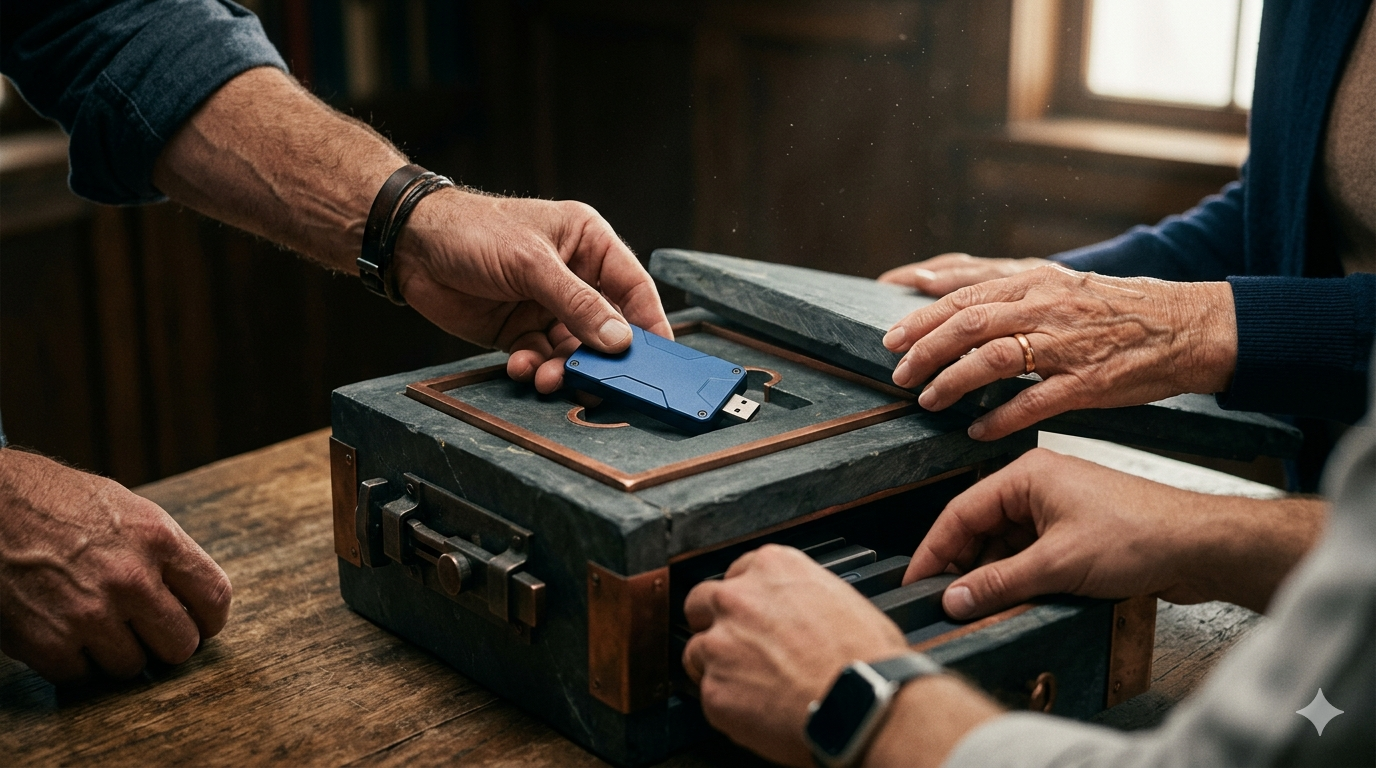
- Key 3: Stored in a secure, geographically separate location, such as a safety deposit box or a professional vault.
In the event of the primary investor's passing, the spouse and the backup key can be combined to move the funds. This prevents a single lost item from resulting in a permanent loss of capital. When setting this up, it is helpful to know how to add a digital will clause to a paper will easily to ensure the legal framework matches the technical reality.
Scenario: A Parent Managing a Multi-Generational Portfolio
In this scenario, a primary investor has accumulated significant assets over a decade. They are the only person in the household with deep technical knowledge. Their spouse is not interested in the mechanics of blockchain, and their two adult children are tech-savvy but live in different cities.
The parent implements a 3-of-5 multi-sig wallet:
- Key 1: Parent’s primary hardware wallet.
- Key 2: Spouse’s hardware wallet (stored in a home safe).
- Key 3: Child A’s hardware wallet (kept at their residence).
- Key 4: Child B’s hardware wallet (kept at their residence).
- Key 5: A backup seed phrase stored with a professional digital legacy service.
The Outcome: If the parent becomes incapacitated in May 2026, the spouse and the two children can combine their three keys to access the funds. No single person can move the money unilaterally, which protects the surviving spouse from potential pressure, and the redundancy ensures that even if one child loses their device, the remaining keys can still recover the assets. This creates a resilient legacy that survives individual errors or device failures.
Technical Execution: Splitting Keys Without Complexity
You do not need to be a developer to set up multi-sig family wallets. Modern tools have simplified the process of splitting access so that it is manageable for non-technical heirs.
For high-net-worth families, using a hardware-based strategy provides the highest level of protection.
- Software Multi-Sig (e.g., Safe): Often used for Ethereum and EVM-compatible chains. It uses smart contracts to manage the logic.
- Hardware Multi-Sig (e.g., Sparrow or Specter): Ideal for Bitcoin. It requires physical hardware devices to sign transactions, meaning keys never touch the internet.
Cold storage remains the gold standard for long-term preservation. In a family multi-sig setup, each signer should ideally have their own hardware wallet. This ensures that even if one person’s computer is compromised, the vault remains secure. While investors often worry about what happens to bank accounts when a bank closes, a self-custodied multi-sig wallet allows the family to act as their own financial institution.
Comparison: Multi-Sig vs. Shared Recovery Seeds
| Feature | Shared Recovery Seed (1-of-1) | Multi-Sig Family Wallet (M-of-N) |
|---|---|---|
| Redundancy | None (1 loss = total loss) | High (can lose N-M keys) |
| Theft Protection | Low (Single point of failure) | High (Requires collusion) |
| Inheritance Flow | Manual and high-risk | Programmatic and structured |
| Technical Difficulty | Low | Moderate to High |
| Coercion Resistance | Minimal | Significant |
Practical Step-by-Step: Setting Up Your Family Multi-Sig
- Select Your Coordinator Software: Choose a platform like Safe for Ethereum or Sparrow Wallet for Bitcoin to manage the multi-signature interface.
- Acquire Diverse Hardware: Purchase hardware wallets from different reputable manufacturers to mitigate the risk of a single supply-chain vulnerability.
- Define the Threshold: Determine your "M-of-N" ratio. A 2-of-3 setup is standard for small families, while a 3-of-5 setup offers better security for larger groups.
- Distribute the Keys: Physically move the signing devices to different geographic locations. Keeping all keys in one home defeats the purpose of the multi-sig redundancy.
- Conduct a Test Transaction: Perform a small "dry run" where at least two signers must authorize a transaction. This ensures everyone understands the process before a crisis occurs.
- Document the Instructions: Create a clear, non-technical manual for your heirs. You can learn how to build a family digital will using Cipherwill today to help automate the delivery of these instructions.
Original Practical Insight: The "Blind Signer" Strategy
A unique recommendation for 2026 is the implementation of a "Blind Signer" for your backup key. This involves a trusted third party or service that holds a key but has no knowledge of the wallet's total balance or the identity of the other signers. Their sole mandate is to provide a signature only when presented with verified legal documentation, such as a death certificate. This prevents any single family member from feeling the psychological burden of holding the "master" access while providing a fail-safe against lost family keys.
Caveats and Limits
While multi-sig is a powerful tool for securing digital wealth for future generations, it is not a universal solution.
- Transaction Fees: Multi-sig transactions are more data-intensive on the blockchain, which can lead to higher network fees compared to standard transactions.
- Complexity Risk: If you choose an overly complex threshold (e.g., 5-of-7) and multiple family members lose access simultaneously, the funds may be permanently locked.
- Legal Recognition: In many jurisdictions, the physical possession of a key does not automatically confer legal ownership. It is essential to consult with a professional regarding digital assets in estate plans.
- Platform Changes: Software coordinators and hardware firmware are subject to updates. A setup created in May 2026 may require maintenance by 2028 to remain compatible with modern standards.
Family Readiness Checklist
| Task | Responsibility | Frequency |
|---|---|---|
| Firmware Updates | Primary Investor | Quarterly |
| Physical Key Audit | All Signers | Annually |
| Test Transaction | Primary + One Heir | Bi-Annually |
| Legal Will Review | Estate Attorney | Every 2 Years |
| Instruction Manual Update | Primary Investor | After any hardware change |
FAQ
- What is a multi-sig family wallet?
It is a cryptocurrency storage solution that requires a predefined number of multiple private keys to authorize a transaction, preventing any single person from having total control.
- Is multi-sig better than a recovery seed phrase?
For inheritance purposes, yes. A single seed phrase is a single point of failure, whereas multi-sig distributes risk across multiple people and locations.
- What happens if a family member loses their hardware wallet?
In an M-of-N setup, the wallet remains accessible as long as the remaining signers meet the threshold. The family should then move the funds to a new wallet with fresh keys.
- Do I need a lawyer to set up a multi-sig wallet?
While the technical setup can be done independently, a lawyer is recommended to ensure the digital asset distribution aligns with your legal estate plan and local tax laws.
- Can multi-sig be used for all types of cryptocurrency?
Most major assets like Bitcoin and Ethereum support multi-sig, but some smaller altcoins may not have native support or easy-to-use coordinator software.
- How do I ensure my heirs know how to use the multi-sig wallet?
Regular "family security drills" and a clear, written instruction manual stored in a secure location are the best ways to ensure technical readiness.
Conclusion: Securing Your Digital Legacy Today
The transition from traditional assets to digital wealth requires a parallel shift in how we approach inheritance. Relying on a single point of access is a significant risk that can lead to the permanent loss of a family's financial legacy. By implementing multi-sig family wallets, you replace vulnerability with redundancy and provide your heirs with a clear, secure path to their inheritance.
The opportunity to protect your wealth is available now, but it requires proactive planning. As of May 2026, the tools for multi-signature security have reached a level of maturity that makes them accessible to the average investor. Your next action should be to audit your current storage method, select your trusted signers, and begin the technical setup of a multi-signature threshold. Failing to act leaves your legacy at the mercy of a single lost device or forgotten password. For further guidance on integrating these tools into a broader plan, refer to Datarecovery.com's guide on crypto inheritance.
Freshness Note: This guide was last reviewed and updated in May 2026 to reflect the latest standards in multi-signature smart contracts and hardware wallet compatibility as defined by the National Institute of Standards and Technology.
About the Author and Reviewer
By Cipherwill Editorial Team, Digital Legacy Research Desk Reviewed by Cipherwill Review Board, Trust & Security Review Team Last reviewed: May 2026 Editorial contributor: Myra Senapati Review contributor: Reyansh Mehta
Legal and Accuracy Caution
Legal and Accuracy Caution: The laws governing digital assets, AI likeness, and posthumous privacy are evolving rapidly and vary significantly by jurisdiction. Platform terms of service and corporate policies are subject to change without notice. This guide provides general information and should not be construed as specific legal or financial advice. Always consult with a qualified professional in your specific region regarding digital estate planning.